Walk onto any plant floor and you’ll find the same conversation happening on repeat: someone holding a pipe spec sheet, staring at a catalog, trying to decide between a gate valve and a ball valve for a line that “just needs to shut off.” Three months later, that valve is leaking, or it won’t throttle properly, or the seat has been chewed up by the process media. The valve wasn’t defective — it was just the wrong valve for the job.
Choosing the right industrial valve isn’t about picking the most popular option or the cheapest one in the catalog. It’s a structured decision built on flow behavior, pressure and temperature limits, the chemistry of what’s flowing through the pipe, and how much automation the process actually needs. Get those factors right, and a valve will run reliably for years with minimal intervention. Get them wrong, and you’re looking at premature failure, unplanned downtime, safety incidents, or product loss.
This guide pulls together the selection logic that valve engineers and manufacturing teams use every day — not generic textbook theory, but the practical checkpoints that determine whether a valve will actually perform in your specific application. Whether you’re specifying valves for a new water treatment line, troubleshooting recurring failures in a chemical plant, or building a procurement checklist for an oil & gas facility, this article will walk you through the complete decision-making framework.
Table of Contents
- What Is an Industrial Valve?
- How Do I Choose the Right Industrial Valve for My Application?
- Step-by-Step Industrial Valve Selection Guide
- Types of Industrial Valves and Their Applications
- Industrial Valve Comparison Table
- Ball Valve vs Butterfly Valve
- Globe Valves vs Control Valves
- Choosing Valves for Different Industries
- Importance of Valve Materials
- Common Mistakes When Selecting Industrial Valves
- How Industrial Control Valves Improve Process Efficiency
- Why Jal Engineering Is Trusted by Industries Across India
- Expert Checklist Before Purchasing Industrial Valves
- Quick Answers
- FAQs
What Is an Industrial Valve?
An industrial valves is a mechanical device installed in a pipeline or process vessel that starts, stops, throttles, or redirects the flow of liquids, gases, slurries, or steam by opening, closing, or partially obstructing a flow passage.
Every valve, regardless of type, exists to manage flow and pressure in a controlled, repeatable way. The differences between valve types come down to how they accomplish that — through linear motion (gate, globe, diaphragm), rotary motion (ball, butterfly), or pressure-actuated motion (relief and check valves).
Key Functions of Industrial Valves
- Isolation — fully stopping flow for maintenance, safety, or process segregation (gate, ball valves).
- Flow regulation — throttling flow to a specific rate (globe, needle, control valves).
- Backflow prevention — allowing flow in one direction only (check valves).
- Pressure protection — automatically venting excess pressure to protect equipment and personnel (pressure relief valves).
- Process control — continuously modulating flow in response to a control signal (control valves).
Types of Industrial Valves
The major categories include gate valves, globe valves, ball valves, butterfly valves, control valves, check valves, pressure relief valves, diaphragm valves, and needle valves. Each is engineered around a specific flow-control behavior, and we cover the application logic for each later in this guide.
Industrial Applications
Industrial valves are used wherever a process fluid needs to be controlled: water and wastewater treatment, oil and gas extraction and refining, chemical and petrochemical processing, pharmaceutical manufacturing, food and beverage production, power generation, HVAC systems, and marine and shipboard piping. The selection logic changes from one industry to the next because the media, pressure, temperature, and hygiene requirements are different — which is exactly why a one-size-fits-all approach to valve buying leads to problems.
How Do I Choose the Right Industrial Valve for My Application?
Choose an industrial valve by matching seven variables to your process: flow requirement (on/off vs. throttling), pressure rating, temperature range, media compatibility (chemical and physical properties of the fluid), automation needs, safety requirements, and applicable regulatory standards. The valve that satisfies all seven — not just the cheapest or most familiar option — is the right one.
Most valve selection mistakes happen because someone optimizes for one variable (usually cost or flow capacity) and ignores the rest. Here’s how each factor actually plays out in practice.
Flow Requirements
Ask whether the application needs on/off isolation or modulating control. Gate and ball valves excel at isolation but perform poorly when used to throttle flow — partial opening causes turbulence, vibration, and accelerated seat wear. Globe, needle, and control valves are built specifically for throttling duty because their internal geometry is designed to handle partial-open flow without damage.
Pressure Requirements
Every valve carries a pressure class (commonly expressed per ASME B16.34 classes such as Class 150, 300, 600, and higher) that defines the maximum pressure it can safely handle at a given temperature. Selecting a valve below the system’s maximum operating pressure — including pressure spikes and surges — is one of the most common and most dangerous selection errors.
Temperature Conditions
Temperature affects two things: the body/trim material’s mechanical strength and the seat/seal material’s integrity. A PTFE-seated ball valve rated for 180°C will fail quickly in a 300°C steam line, even if the pressure rating looks adequate on paper. Always check the combined pressure-temperature rating, not pressure alone.
Media Compatibility
This is where corrosion, erosion, and chemical attack happen. Media compatibility covers the fluid’s corrosiveness, viscosity, presence of solids or slurry, and whether it’s food-grade, sanitary, or hazardous. A stainless steel body can still fail if the elastomer seat isn’t rated for the specific chemical passing through it — body material and seat material need to be checked independently.
Automation Requirements
Decide early whether the valve needs to be manually operated, motor-actuated, pneumatically actuated, or fully integrated into a control loop with a positioner and transmitter. Retrofitting actuation onto a valve that wasn’t designed for it is more expensive than specifying it correctly from the start.
Safety Considerations
For hazardous, high-pressure, or high-temperature services, valves often need fire-safe design, fugitive emission certification, or fail-safe actuator behavior (fail-open or fail-closed on loss of signal/air). These aren’t optional extras for critical safety loops — they’re often mandatory.
Regulatory Standards
Depending on the industry, valves may need to comply with ASME B16.34, API 600/602/608, IBR (Indian Boiler Regulations) for steam applications, PESO approval for petroleum and hazardous installations, or 3-A/ASME BPE sanitary standards for pharma and food processing. Confirming the applicable code before ordering avoids costly rework and compliance failures during inspection.
Step-by-Step Industrial Valve Selection Guide
A reliable valve selection process follows eight sequential steps: identify the process media, determine flow rate, evaluate pressure ratings, analyze temperature conditions, select valve material, assess corrosion resistance, plan for maintenance, and evaluate automation needs — in that order, because each step narrows the field of suitable valve types.
Step 1: Understand Process Media
Start with the fluid itself. Is it clean water, a corrosive acid, an abrasive slurry, a flammable hydrocarbon, or a hygienic food product? The media determines which body and seal materials are even eligible for consideration before you look at anything else.
Step 2: Determine Flow Rate
Calculate the required flow rate (in m³/hr or LPM) and the pipe’s nominal diameter. This determines valve size and helps identify whether you need a full-bore design (gate, ball) for minimal pressure drop or a design optimized for control accuracy (globe, control valve) over raw flow capacity.
Step 3: Evaluate Pressure Ratings
Identify the maximum sustained operating pressure plus any transient pressure spikes (water hammer, pump surge, thermal expansion). Select a valve pressure class with adequate margin — engineers commonly build in headroom rather than specifying right at the calculated maximum.
Step 4: Analyze Temperature Conditions
Map both the normal operating temperature and any upset-condition extremes. Confirm the valve’s pressure-temperature derating curve from the manufacturer, since most metallic and elastomeric materials lose pressure capacity as temperature rises.
Step 5: Select Valve Material
Match the body, trim, and seat materials to the media and temperature profile established in Steps 1–4. We cover specific material trade-offs in detail in the materials section below.
Step 6: Consider Corrosion Resistance
Corrosion is rarely uniform — it can be general, pitting, crevice, or galvanic, depending on the media and the materials in contact. For corrosive or marine environments, stainless steel, duplex steel, or specialty alloys are often non-negotiable even if the upfront cost is higher than carbon steel.
Step 7: Determine Maintenance Needs
Consider how often the valve will be cycled, whether it needs to be repaired in-line or removed, and how accessible it will be once installed. Valves in hard-to-reach locations should favor designs with long service intervals and simple seat/seal replacement.
Step 8: Evaluate Automation Requirements
Finally, confirm whether the valve needs manual operation, electric or pneumatic actuation, or integration with a plant control system. This step is last because automation hardware (actuators, positioners, limit switches) must be matched to a valve design that’s already been confirmed suitable for the process.
Types of Industrial Valves and Their Applications
The nine core industrial valve types — gate, globe, ball, butterfly, control, check, pressure relief, diaphragm, and needle valves — each serve a distinct flow-control function, ranging from full on/off isolation to precise automated throttling, and selecting among them depends primarily on whether the application needs isolation, regulation, backflow prevention, or safety relief.
Gate Valves
Gate valves use a flat or wedge-shaped gate that slides perpendicular to the flow path. When fully open, they offer a nearly unrestricted, full-bore flow path with minimal pressure drop — which is exactly why they’re the default choice for on/off isolation in pipelines, water distribution networks, and oil & gas transmission lines. They are not designed for throttling; partial opening exposes the gate edge to high-velocity flow, causing vibration, wire-drawing erosion, and premature seat damage.
Globe Valves
Globe valves force flow through an S-shaped internal path, which creates more pressure drop than a gate valve but gives much finer control over flow rate. This makes them the preferred manual valve for throttling duty — applications like boiler feedwater, chemical injection, and cooling water systems where flow needs to be adjusted, not just stopped.
Ball Valves
A ball valve uses a bored sphere that rotates 90 degrees to open or close the flow path. They offer fast, tight, bubble-tight shutoff with low pressure drop, making them extremely popular across oil & gas, chemical, and general industrial isolation duty. Standard ball valves are poor at fine throttling, though V-port and segmented-ball variants are specifically engineered for control applications.
Butterfly Valves
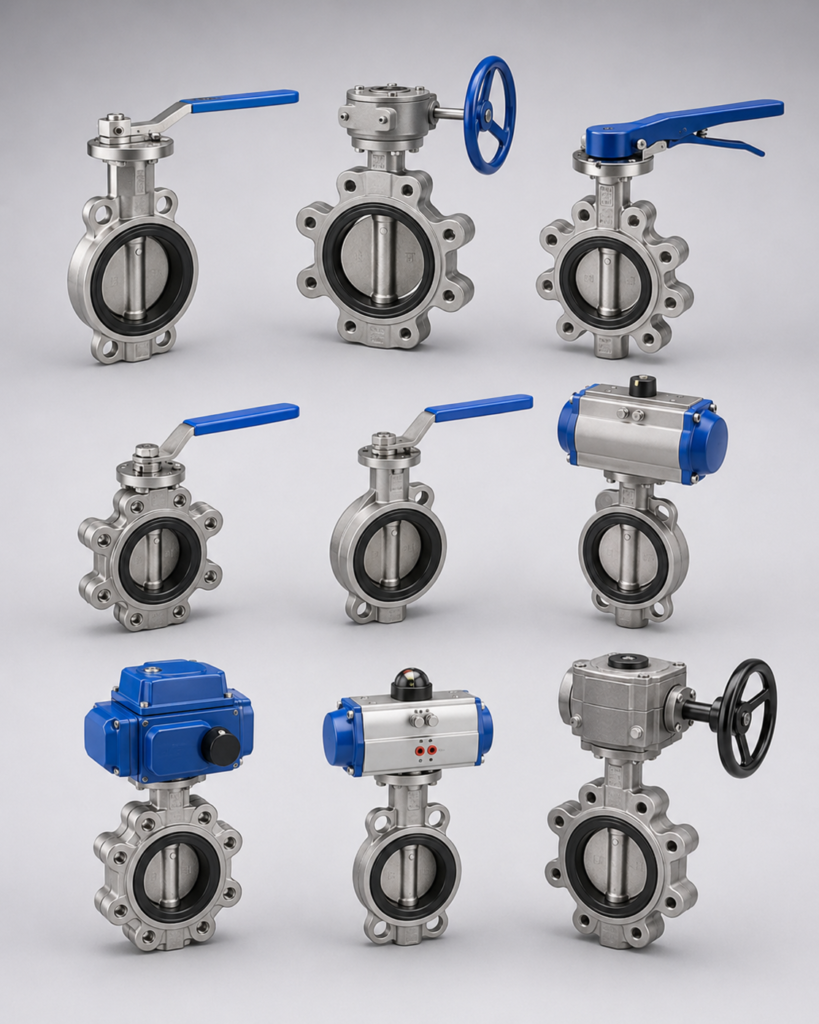
A butterfly valve uses a disc that rotates within the flow path on a central shaft. They are compact, lightweight, and cost-effective, especially in larger pipe diameters, which makes them the go-to choice for water treatment, HVAC, and large-bore process lines where full ball or gate valve cost would be hard to justify.
Control Valves
Control valves are automated valves — frequently globe-style internally — fitted with an actuator and positioner that continuously adjusts valve position in response to a control signal from a PLC or DCS. They are the backbone of automated process control wherever flow, pressure, level, or temperature needs to be held at a precise setpoint without manual intervention.
Check Valves
Check valves allow flow in one direction only, closing automatically when flow reverses or stops. Swing, lift, and wafer-style check valves protect pumps from backflow damage and prevent contamination or siphoning in water, chemical, and process piping systems.
Pressure Relief Valves
Pressure relief valves (also called safety valves) open automatically once system pressure exceeds a calibrated setpoint, venting excess pressure to protect vessels, boilers, and pipelines from overpressure failure. These are critical safety devices, not optional flow-control accessories, and are typically sized and certified to a specific code (such as ASME Section VIII).
Diaphragm Valves
Diaphragm valves use a flexible diaphragm that flexes into the flow path to throttle or stop flow, while completely isolating the process media from the valve’s working mechanism. This makes them ideal for corrosive, abrasive, or hygienic services — chemical slurries, pharmaceutical fluids, and food-grade products that can’t tolerate metal-to-metal moving parts in the flow path.
Needle Valves
Needle valves use a long, tapered, needle-like plug to provide extremely precise control over very small flow rates. They are widely used in instrumentation lines, sampling systems, and calibration setups where accuracy at low flow matters more than flow capacity.
Industrial Valve Comparison Table
Table Snippet: A side-by-side comparison of the five most common industrial valve types across flow control, pressure handling, cost, maintenance, and best-fit application.
| Valve Type | Flow Control | Pressure Handling | Cost | Maintenance | Best Application |
|---|---|---|---|---|---|
| Gate Valve | Poor for throttling; excellent for full on/off | High, with full-bore design | Low–Medium | Moderate (gland packing, seat wear if throttled) | Pipeline isolation, water distribution |
| Globe Valve | Excellent throttling accuracy | Medium–High | Medium | Moderate (higher pressure drop accelerates wear) | Flow regulation, boiler feedwater, chemical dosing |
| Ball Valve | Good on/off; limited throttling unless V-port | High | Medium | Low (simple quarter-turn design) | Quick isolation, oil & gas, general process lines |
| Butterfly Valve | Moderate throttling | Low–Medium | Low | Low | Large-diameter lines, water treatment, HVAC |
| Control Valve | Excellent, automated, continuous | Application-dependent | High | Higher (actuator, positioner upkeep) | Automated process control loops |
Ball Valve vs Butterfly Valve
Ball valves provide tighter shutoff and handle higher pressures in smaller pipe sizes, while butterfly valves are lighter, cheaper, and better suited to large-diameter, lower-pressure lines.
| Factor | Ball Valve | Butterfly Valve |
|---|---|---|
| Shutoff Quality | Bubble-tight, excellent | Good, but slightly less tight than ball valves |
| Pressure Rating | Higher pressure capability | Generally lower pressure rating |
| Size Range | Best for small to mid-size lines | Excels in large-diameter lines |
| Weight & Footprint | Heavier, bulkier in larger sizes | Compact and lightweight |
| Cost | Higher in larger sizes | More economical, especially in large bore |
| Throttling | Limited (unless V-port design) | Moderate throttling capability |
Advantages of Ball Valves: Tight sealing, durability, low operating torque, simple quarter-turn operation, strong performance with gases and high-pressure liquids.
Disadvantages of Ball Valves: Becomes heavy and costly in large sizes; standard designs are not ideal for fine flow control.
Best Use Cases: Oil & gas isolation points, compressed air and gas lines, chemical process isolation, and any application needing fast, reliable, tight shutoff.
Advantages of Butterfly Valves: Lightweight, compact, lower cost in large sizes, fast quarter-turn operation, easy to automate.
Disadvantages of Butterfly Valves: Lower pressure/temperature ceiling, disc can create some flow restriction even when fully open, less precise shutoff than ball valves in critical isolation duty.
Best Use Cases: Water and wastewater treatment plants, HVAC chilled/hot water systems, and large-bore process lines where ball valve cost would be excessive.
Globe Valves vs Control Valves
Globe valves are manually operated throttling valves offering good (but operator-dependent) flow regulation, while control valves are automated, actuator-driven valves designed for continuous, precise, programmable flow control within a process loop.
| Factor | Globe Valve | Control Valve |
|---|---|---|
| Accuracy | Good, but limited by manual adjustment | Excellent, precise and repeatable |
| Flow Regulation | Manual throttling | Automated, continuous modulation |
| Automation | Typically manual (handwheel) | Built for actuation and control-loop integration |
| Cost | Lower upfront cost | Higher upfront cost (actuator, positioner, instrumentation) |
| Applications | Manual flow adjustment, isolation with throttling capability | Closed-loop process control, automated plants |
In practice, many control valves use a globe-valve-style body internally — the difference is the actuation and instrumentation layer added on top. A plant that starts with manually-operated globe valves often upgrades specific control points to automated control valves as the process matures toward full automation.
Choosing Valves for Different Industries
Valve selection changes by industry because the process media, hygiene requirements, pressure/temperature extremes, and regulatory codes differ significantly — a valve that performs perfectly in water treatment can fail outright in pharmaceutical or oil & gas service.
Water Treatment Plants
Recommended valves: Gate valves for main line isolation, butterfly valves for flow control on large-diameter lines, diaphragm valves for chemical dosing (chlorine, alum, polymers).
Material recommendations: Ductile iron and cast iron for general water service; rubber-lined or stainless steel for chemical dosing and slurry contact points.
Common mistakes: Using unlined valves on chemical dosing lines, leading to rapid internal corrosion.
Expert tip: Specify rubber-lined or EPDM-seated butterfly valves anywhere chlorine or other oxidizing chemicals contact the valve body.
Chemical Processing Plants
Recommended valves: Diaphragm valves and lined ball valves for corrosive media, control valves for precise chemical dosing and reaction control.
Material recommendations: Stainless steel or PTFE/PVC-lined bodies depending on the specific chemical’s aggressiveness.
Common mistakes: Checking only the body material’s chemical compatibility while overlooking the seat, seal, or diaphragm material — which often fails first.
Expert tip: Always cross-reference both body and elastomer/seal material against a chemical compatibility chart for the exact concentration and temperature involved, not just the chemical name.
Oil and Gas Facilities
Recommended valves: Gate and ball valves for pipeline isolation, check valves to prevent backflow at pump stations, pressure relief valves for overpressure protection.
Material recommendations: Carbon steel and alloy steel for most service; forged steel trim for high-pressure, sour, or high-temperature wells.
Common mistakes: Selecting valves by nominal pressure class alone without verifying compliance with API 600/602/608 and ASME B16.34 requirements for the specific service class.
Expert tip: For sour or high-H2S service, confirm NACE MR0175 material compliance — standard carbon steel trim can suffer sulfide stress cracking.
Pharmaceutical Manufacturing
Recommended valves: Sanitary diaphragm valves and hygienic ball valves with crevice-free, polishable internal surfaces.
Material recommendations: 316L stainless steel with a mirror or electropolished finish.
Common mistakes: Using standard industrial-grade valves instead of sanitary-design valves, leaving dead legs or crevices where bacteria can accumulate.
Expert tip: Confirm the valve design supports CIP (clean-in-place) and SIP (sterilize-in-place) cycles and meets 3-A or ASME BPE sanitary standards before specifying.
Food and Beverage Processing
Recommended valves: Sanitary butterfly and diaphragm valves with smooth, crevice-free internal geometry.
Material recommendations: 304 or 316 stainless steel, food-grade elastomer seats (EPDM or Viton, FDA-compliant grades).
Common mistakes: Overlooking FDA/food-grade certification of seat and seal materials, even when the body material is correct.
Expert tip: Choose valves with a quick-disassembly design to simplify routine cleaning and inspection in high-frequency CIP environments.
Power Generation Plants
Recommended valves: Globe and control valves for steam and feedwater regulation, pressure relief valves for boiler protection.
Material recommendations: Alloy steel (chrome-moly grades) for high-temperature, high-pressure steam service.
Common mistakes: Selecting valve trim materials rated for pressure but not for steam-erosion resistance at high velocity.
Expert tip: Verify the valve’s pressure-temperature derating curve against actual superheated steam conditions, not just cold working pressure.
HVAC Systems
Recommended valves: Butterfly and ball valves for chilled/hot water isolation, control valves for zone temperature modulation.
Material recommendations: Bronze, brass, or ductile iron, depending on pipe size and pressure class.
Common mistakes: Oversizing control valves relative to actual system flow, which causes poor low-load control and valve “hunting.”
Expert tip: Size control valves to the actual calculated flow rate at design conditions — not simply to match the pipe’s nominal diameter.
Marine Applications
Recommended valves: Bronze or stainless steel ball and gate valves for seawater systems, check valves for bilge and ballast lines.
Material recommendations: Marine-grade bronze, duplex stainless steel, or specially coated carbon steel for saltwater contact.
Common mistakes: Using standard carbon steel valves in seawater service, leading to rapid corrosion failure.
Expert tip: For critical seawater lines, duplex or super-duplex stainless steel outperforms standard 316 stainless in resisting chloride pitting and crevice corrosion.
Importance of Valve Materials
Valve material determines pressure capacity, temperature tolerance, and corrosion resistance — choosing the wrong material is one of the leading causes of premature valve failure, even when the valve type itself was correctly selected.
| Material | Corrosion Resistance | Pressure/Temp Capability | Typical Cost | Best Suited For |
|---|---|---|---|---|
| Cast Iron | Low | Low–Medium | Low | General low-pressure water service |
| Ductile Iron | Low–Medium | Medium | Low–Medium | Municipal water and wastewater valves |
| Carbon Steel | Medium (needs coating in corrosive media) | High | Medium | Oil & gas, steam, general process piping |
| Stainless Steel | High | Medium–High | Medium–High | Chemical, pharma, food & beverage, marine |
| Brass | Medium | Low–Medium | Low–Medium | Plumbing, HVAC, smaller-bore water/gas lines |
| Bronze | High (especially in water/marine) | Medium | Medium | Marine systems, water valve trim and seats |
| Alloy Steel | Medium–High (application-dependent) | Very High | High | High-temperature, high-pressure power and refining service |
Material selection should always be checked against both the body and the trim/seat/seal — a stainless steel body paired with an incompatible elastomer seat will still fail in service, just at a different point in the valve.
Common Mistakes When Selecting Industrial Valves
The most frequent industrial valve selection mistakes are: choosing by price alone, wrong pressure rating, wrong material, ignoring temperature limits, oversizing, undersizing, ignoring maintenance access, ignoring corrosion resistance, using isolation valves for throttling duty, and skipping regulatory compliance checks.
- Selecting based only on price — the cheapest valve is rarely the lowest lifecycle cost once failure, downtime, and replacement are factored in.
- Wrong pressure rating — specifying a valve class below the system’s actual maximum operating pressure, including transient spikes.
- Wrong material selection — choosing a body or seat material incompatible with the process media’s chemistry.
- Ignoring temperature limits — overlooking how seat and seal materials degrade or harden outside their rated temperature window.
- Oversizing valves — installing a valve larger than the application needs, which hurts control accuracy and increases cost unnecessarily.
- Undersizing valves — choosing a valve too small for the flow rate, causing excessive pressure drop, cavitation, or erosion.
- Ignoring maintenance needs — selecting a valve that’s difficult to access or repair once installed in its final location.
- Ignoring corrosion resistance — underestimating pitting, crevice, or galvanic corrosion risks specific to the media and environment.
- Using on/off valves for throttling — running gate or standard ball valves in a partially open position, which accelerates seat wear and causes vibration.
- Overlooking automation requirements upfront — choosing a valve body that’s difficult or impossible to retrofit with an actuator later.
- Skipping regulatory compliance — failing to confirm applicable codes (ASME, API, IBR, PESO) before purchase, which can trigger costly rework during inspection or commissioning.
- Ignoring flow direction and water hammer risk — installing valves (especially check valves) without considering surge pressure from rapid closure.
How Industrial Control Valves Improve Process Efficiency
Industrial control valves improve process efficiency by replacing manual, imprecise flow adjustment with automated, continuous modulation — reducing raw material waste, energy consumption, and unplanned downtime while improving product consistency.
Flow Control: A control valve holds flow, pressure, level, or temperature at a precise setpoint continuously, rather than relying on an operator periodically adjusting a handwheel.
Automation: Integrated with a plant’s PLC or DCS, control valves respond to real-time process data automatically, which is essential for plants running 24/7 with limited manual oversight.
Energy Savings: Precise modulation prevents over-pumping, over-heating, or over-dosing — each of which wastes energy or raw material when controlled manually with on/off or coarse throttling valves.
Reduced Downtime: Modern control valves with smart positioners provide diagnostic feedback (stem position, friction, response time), allowing maintenance teams to spot developing issues before a failure stops production.
Better Process Accuracy: In applications like pH neutralization or chemical dosing, a control valve maintains a tighter tolerance band than manual adjustment — directly improving product quality and reducing rework or batch rejection.
Real example: A chemical plant dosing acid into a neutralization tank using a manually-throttled globe valve will typically see wider pH swings and occasional overdosing, increasing both chemical consumption and downstream effluent treatment cost. Replacing that manual valve with an automated control valve tied to an inline pH sensor tightens the control band significantly, cutting chemical overconsumption and reducing the load on the effluent treatment system — a pattern we see repeatedly across dosing and blending applications in the field.
Why Jal Engineering Is Trusted by Industries Across India
Selecting the right valve type and material is only half the equation — the other half is sourcing it from a manufacturer who actually understands the application, not just the catalog number.
Jal Engineering, based in Ahmedabad, Gujarat, is a manufacturer and supplier of industrial valves, stainless steel flanges, and industrial pipe fittings, supplying industries including oil & gas, chemical processing, pharmaceutical, food & beverage, and water treatment. As one of the established valve manufacturers in India, the company’s product range spans ball valves, butterfly valves, gate valves, globe valves, check valves, buttweld fittings, flanges, and stainless steel pipes — giving plant engineers and procurement teams a single industrial valve supplier for both the valves and the connecting piping components in a system.
Manufacturing expertise: Jal Engineering’s operations are built around process-driven manufacturing — meaning production follows defined, repeatable processes rather than ad-hoc fabrication, which is exactly the kind of consistency industrial buyers should look for in a long-term industrial valve manufacturer.
Quality assurance: Products go through dimensional, finish, and functional verification before dispatch, reflecting a controlled-quality approach to manufacturing rather than a purely volume-driven one.
Custom engineering capabilities: Beyond stock valve sizes and configurations, Jal Engineering works with application-specific requirements, helping buyers match valve type, material, and end connections to their actual process conditions rather than forcing a standard part into a non-standard application.
Technical support: As a valve supplier in Ahmedabad, the team works directly with engineers and procurement managers to clarify pressure class, material compatibility, and standards compliance before an order is placed — the same selection logic outlined throughout this guide.
If you’re sourcing industrial control valves, a stainless steel flanges manufacturer, or pipe fittings industrial components for a new or existing system, working with a single accountable manufacturer for valves, flanges, and fittings simplifies both technical coordination and long-term spare parts availability.
Expert Checklist Before Purchasing Industrial Valves
Use this checklist before finalizing any industrial valve order:
- Process media identified (chemical composition, viscosity, solids content)
- Required flow rate calculated and documented
- Maximum operating pressure confirmed, including transient spikes
- Operating and upset-condition temperature range confirmed
- Valve type matched to duty (isolation vs. throttling vs. control)
- Body, trim, and seat material checked against media compatibility
- Corrosion risk assessed (general, pitting, crevice, galvanic)
- End connection type confirmed (flanged, threaded, buttweld) and matched to existing piping
- Maintenance access and expected service interval reviewed
- Automation requirement defined (manual, electric, pneumatic, control-loop integration)
- Applicable regulatory standard identified (ASME, API, IBR, PESO, 3-A/BPE)
- Total lifecycle cost compared, not just unit purchase price
- Supplier’s manufacturing and quality control process verified
1. An industrial valve is a mechanical device that controls the flow of liquids, gases, slurries, or steam in a pipeline by opening, closing, or partially restricting the flow passage.
2. How to Choose an Industrial Valve
- Identify the process media
- Determine required flow rate
- Confirm pressure rating
- Confirm temperature range
- Select compatible material
- Assess corrosion resistance
- Plan for maintenance access
- Define automation requirements
3. Comparison Snippet Ball valves offer tighter shutoff and higher pressure capability in smaller pipe sizes; butterfly valves are lighter and more economical in large-diameter, lower-pressure lines.
4. Table Snippet
| Need | Recommended Valve |
|---|---|
| Tight on/off shutoff | Ball Valve |
| Precise manual throttling | Globe Valve |
| Automated process control | Control Valve |
| Large-diameter, lower-cost isolation | Butterfly Valve |
| Backflow prevention | Check Valve |
| Overpressure protection | Pressure Relief Valve |
Frequently Asked Questions
1. How do I choose the right industrial valve for my application? Match the valve to seven factors: flow requirement (isolation vs. throttling), pressure rating, temperature range, media compatibility, automation needs, safety requirements, and applicable regulatory standards. Start by identifying your process media and flow rate, then narrow down valve type, material, and automation level based on pressure, temperature, and the codes that apply to your industry. Skipping any one of these factors — especially media compatibility or pressure rating — is the most common reason valves underperform or fail prematurely. A structured, step-by-step selection process consistently outperforms choosing by familiarity or price alone, and it’s worth involving your valve supplier’s technical team early if your application involves unusual pressure, temperature, or chemical conditions.
2. What is the difference between globe valves and control valves?
Globe valves are manually operated valves with an S-shaped internal flow path designed for throttling — an operator turns a handwheel to adjust flow. Control valves are automated valves, often built on a similar internal body design, fitted with an actuator and positioner that continuously adjusts position based on a signal from a plant’s control system. In short, a globe valve gives you manual throttling control, while a control valve gives you automated, continuous, programmable control. Many plants use globe valves at simpler manual points and reserve control valves for loops that require precise, automated regulation, such as temperature or pressure control tied to a PLC or DCS.
3. Which valve is best for high-pressure industrial systems?
Gate valves and ball valves, manufactured in carbon steel, alloy steel, or forged steel, are generally the most suitable for high-pressure isolation duty, while globe valves and control valves with appropriately rated trim handle high-pressure throttling. The “best” valve depends on whether you need on/off isolation or continuous flow regulation — there isn’t a single universal answer. What matters most is confirming the valve’s pressure class (per ASME B16.34 or equivalent) against your system’s maximum operating pressure, including transient surges, and verifying compliance with relevant codes such as API 600 or API 602 for high-pressure oil & gas service.
4. How do industrial control valves improve process efficiency?
Control valves replace manual, imprecise flow adjustment with continuous, automated modulation tied to real-time process data. This reduces raw material and energy waste from over-dosing or over-pumping, improves product consistency by holding tighter control tolerances, and — with modern smart positioners — provides diagnostic data that helps maintenance teams catch developing issues before they cause unplanned downtime. The efficiency gain compounds in processes that run continuously, where even small improvements in control accuracy translate into significant savings in chemical consumption, energy use, and rework over time.
5. What factors should I consider when selecting industrial valves?
The core factors are process media compatibility, required flow rate, pressure rating, temperature range, material selection, corrosion resistance, maintenance accessibility, and automation requirements. Beyond these technical factors, also consider the applicable regulatory standards for your industry (such as API, ASME, IBR, or 3-A/BPE sanitary standards), the total lifecycle cost rather than just purchase price, and the reliability of your supplier’s manufacturing and quality control processes. Treating valve selection as a structured, multi-factor decision — rather than a single-criterion choice — is what separates reliable, long-running installations from valves that fail or underperform within the first year.
6. Where can I find a reliable valve supplier in Ahmedabad? Ahmedabad is one of India’s established hubs for valve and pipe fitting manufacturing, with several manufacturers serving both domestic and export markets. Jal Engineering, based in Ahmedabad, Gujarat, manufactures and supplies industrial valves, stainless steel flanges, and pipe fittings to industries including oil & gas, chemical, pharmaceutical, food & beverage, and water treatment. When evaluating any valve supplier in Ahmedabad, ask about their manufacturing process controls, material traceability, ability to support custom specifications, and capacity to supply both valves and the associated piping components (flanges, fittings) from a single source.
7. Who are the leading valve manufacturers in India?
India has a well-developed industrial valve manufacturing base, particularly concentrated around Gujarat (Ahmedabad), Maharashtra, and parts of South India, serving both domestic industries and export markets. Manufacturers range from large multinational-affiliated producers to specialized regional manufacturers like Jal Engineering, which focuses on industrial valves, stainless steel flanges, and pipe fittings for sectors including oil & gas, chemical, pharmaceutical, food & beverage, and water treatment. When comparing manufacturers, look beyond brand recognition to manufacturing process consistency, quality control practices, material certification, and the supplier’s ability to support your specific application rather than just stocking standard catalog items.
8. Why are globe valves commonly used in industrial applications?
Globe valves are widely used because their S-shaped internal flow path gives operators precise, stable control over flow rate — something gate and standard ball valves can’t do well without accelerated wear. This makes them the standard choice for manual throttling duty in applications like boiler feedwater regulation, chemical dosing, and cooling water flow adjustment. The trade-off is a higher pressure drop than a full-bore valve like a gate valve, which is an acceptable cost given the control accuracy gained — and is precisely why globe valves remain a staple in process plants despite the availability of other valve types.
9. How do I select the right industrial pipe fittings for my system?
Start with the same core variables used for valve selection: process media, pressure rating, temperature range, and pipe material. Then confirm the fitting type needed — elbows, tees, reducers, or couplings — based on the pipe routing and any change in direction, branch, or diameter required. Material should match or be metallurgically compatible with the connected piping and valves to avoid galvanic corrosion at the joint, and end connection type (buttweld, threaded, or flanged) must match your existing piping standard. For corrosive or hygienic applications, stainless steel buttweld fittings are generally the safer long-term choice over carbon steel.
10. Why choose a stainless steel flanges manufacturer for industrial projects?
Flanges are the connection point between valves, pipes, and equipment, so their material and dimensional accuracy directly affect system integrity, leak prevention, and long-term corrosion resistance. A dedicated stainless steel flanges manufacturer typically offers tighter dimensional control, documented material traceability, and the ability to match flange specifications (pressure class, facing type, bolt pattern) precisely to your valve and piping standards. Sourcing flanges from the same manufacturer supplying your valves and fittings also simplifies technical coordination and reduces the risk of mismatched standards across a system.
11. What industries use industrial control valves?
Control valves are used wherever a process variable needs continuous, automated regulation: chemical and petrochemical processing (dosing, reaction control), oil & gas (pressure and flow regulation), power generation (steam and feedwater control), water and wastewater treatment (chemical dosing, flow balancing), pharmaceutical manufacturing (precise ingredient dosing), and food & beverage processing (temperature and flow control in production lines). Essentially, any industry running automated, continuous processes with a PLC or DCS relies on control valves as the final actuating element that translates a control signal into a physical change in flow.
12. How often should industrial valves be maintained?
Maintenance frequency depends on valve type, duty cycle, and process severity, but most industrial valves should be visually inspected during routine plant walkdowns and undergo a more thorough functional check — verifying seat tightness, actuator response, and packing condition — on a quarterly to annual schedule. Valves in severe service (high cycling frequency, abrasive or corrosive media, high temperature) typically need more frequent attention than valves used purely for isolation in benign service. Many plants also follow manufacturer-recommended maintenance intervals and incorporate valve condition into broader preventive maintenance and reliability programs rather than waiting for failure.
13. What’s the difference between ball, gate, and check valves?
Ball valves use a rotating bored sphere for fast, tight on/off shutoff with low pressure drop. Gate valves use a sliding gate for full-bore on/off isolation with minimal flow restriction when fully open, but they’re unsuitable for throttling. Check valves are fundamentally different in purpose — rather than being manually or automatically operated for isolation, they open and close automatically based on flow direction, allowing flow one way and preventing backflow the other way. In short: ball and gate valves are operator-controlled isolation valves, while check valves are self-acting backflow-prevention devices.
14. How to fix low water pressure in industrial pipes?
Low pressure in industrial piping is usually caused by an undersized valve or pipe restricting flow, a partially closed or malfunctioning valve, scale or debris buildup inside the valve or pipe, or a valve that’s been selected with too much pressure drop for the application (such as a globe valve used where a full-bore gate or ball valve would be more appropriate). Start by checking valve position and condition, then inspect for internal scaling or blockage, and verify that valve and pipe sizing actually match the system’s design flow rate. If pressure loss is isolated to one section, a single undersized or degraded valve is often the culprit rather than a system-wide issue.
15. What size valves and pipes do I need for my system? Valve and pipe sizing should be based on the required flow rate (in m³/hr or LPM) and an acceptable pressure drop for the application, not simply matched to existing pipe diameter by default. Undersized valves create excessive pressure drop, noise, and erosion; oversized valves hurt control accuracy and add unnecessary cost. As a general approach, calculate your design flow rate, select pipe diameter to keep velocity within recommended limits for your fluid type, and then size the valve to the pipe — adjusting for the specific valve type’s flow characteristics (full-bore vs. restrictive) rather than assuming valve size always equals pipe size.
Conclusion
Choosing the right industrial valve isn’t a single decision — it’s the outcome of working through process media, flow rate, pressure, temperature, material, corrosion risk, maintenance access, and automation needs in a structured order. Skip any one of these, and even a well-manufactured valve can underperform or fail early in an application it was never suited for.
The practical takeaway: start with what’s flowing through the pipe and how it needs to be controlled (isolation vs. throttling vs. automated regulation), then layer in pressure and temperature limits, confirm material compatibility for both the body and the seals, and only then think about automation and long-term maintenance. Industries differ — what works in a water treatment plant won’t necessarily hold up in a pharmaceutical cleanroom or an offshore platform — so always validate your selection against the specific codes and conditions of your industry rather than relying on a generic valve recommendation.
A reliable valve, correctly matched to its application, should run for years with predictable, low-maintenance performance. That reliability starts at the selection stage, not after installation.
Get Expert Help Choosing Your Next Industrial Valve
Specifying the right valve gets easier with an experienced manufacturer on your side. Jal Engineering manufactures and supplies industrial valves, globe valves, control valves, industrial pipe fittings, and stainless steel flanges for industries across India — backed by technical guidance to help you match valve type, material, and automation level to your exact process conditions.
Whether you’re sourcing a single replacement valve or specifying a complete valve and piping package for a new plant, our team can help you avoid the common selection mistakes covered in this guide and supply quality-controlled, application-matched products with nationwide delivery.
Contact Jal Engineering today to discuss your industrial valve, flange, or pipe fitting requirements and get expert, application-specific recommendations — not just a catalog quote.