Every industrial piping system no matter how well-engineered carries an invisible threat: particulate contamination. Rust, pipe scale, weld slag, sand, and process debris travel silently through your pipelines and attack the equipment you depend on most. Pumps lose performance. Control valves stick. Heat exchangers foul. Flow meters drift out of calibration. And the real cost is never just the component it’s unplanned downtime, emergency maintenance, and lost production.
This is exactly the problem a Y Type Strainer is built to solve. Simple in design, powerful in function, and remarkably cost-effective it is one of the most essential protection devices in any process piping system.
In this guide, written from over two decades of hands-on experience in industrial valve and strainer manufacturing in India, we cover everything a plant engineer, procurement manager, or project buyer needs to know about Y type strainers how they work, which type fits your service, where they are used, and how to maintain them for long service life.
What Is a Y Type Strainer?
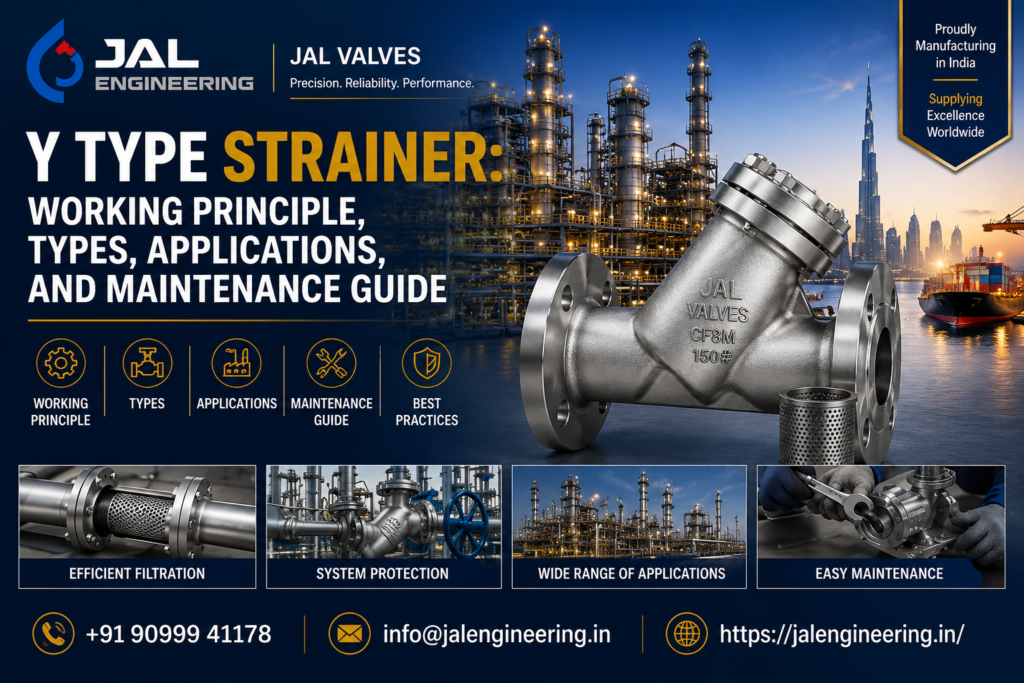
A Y Type Strainer is a mechanical inline filtration device installed in a pipeline to intercept and collect solid particles — dirt, scale, rust flakes, pipe debris from the process fluid before they reach sensitive downstream equipment.
The name comes directly from its shape: viewed from the side, the strainer body forms a clear ‘Y’ figure. The angled lower leg houses a cylindrical or conical mesh screen element where filtration actually happens. Process fluid enters through the inlet, passes through the screen (particles stay behind), and clean fluid exits downstream — continuously, passively, and without any moving parts.
Y strainers are used in steam, water, oil, gas, chemical, and cryogenic pipelines and are manufactured in a wide range of materials, pressure classes, and end connection types to suit virtually every industrial service condition.
How Does a Y Type Strainer Work? (Working Principle Explained)
The working principle of a Y type strainer is elegantly simple — which is a significant part of why it has remained the preferred pipeline protection solution across industries for decades.
Step-by-Step Working Process
- Fluid enters the strainer body through the inlet port, directed by the flow arrow marked on the body exterior.
- Inside the body, the fluid is channelled into the straining element — a perforated cylinder or wire mesh basket angled along the lower Y leg.
- Solid particles larger than the mesh opening size are captured on the inner surface of the screen. The fluid itself passes freely through the mesh openings.
- Clean, filtered fluid exits through the outlet port and flows safely to downstream equipment — pumps, valves, instruments, heat exchangers, or nozzles.
- As the strainer operates, collected debris builds up on the screen surface. The differential pressure across the strainer increases gradually as the screen loads up. This rising ΔP is the key signal that cleaning is required.
- The screen is cleaned or replaced through the drain plug or blow-down valve at the bottom of the Y leg — in many configurations, without taking the line out of service.
| Installation Note: Standard installation is horizontal with the screen leg pointing downward, allowing gravity to assist debris collection and drainage. Some Y strainer designs also support vertical installation always check the manufacturer’s recommendation and confirm the flow direction arrow is correctly oriented during installation. |
Types of Y Type Strainers: A Complete Overview
Choosing the right type of Y strainer starts with understanding what each variant is designed to do. Here are the main types available in 2026, along with where each type fits best:
1. Standard Y Type Strainer
The workhorse of the strainer world. Cast or fabricated body in cast iron, carbon steel (WCB), or stainless steel — available in flanged, threaded, and socket weld connections. Suitable for water, steam, oil, air, and general process fluids at standard pressure and temperature conditions. The most widely specified strainer type across industries globally.
2. High-Pressure Y Type Strainer
Engineered for demanding services where line pressure exceeds standard ratings — ANSI Class 600# to 2500#. Uses a forged body (A105, F316, F51 duplex) for structural integrity. Mandatory in high-pressure oil & gas wellheads, steam superheater lines, hydrocracker feed, and similar critical applications. As a high pressure ball valve manufacturer and strainer specialist, Jal Engineering and Jal Valves regularly supply these for upstream and midstream oil & gas projects.
3. Stainless Steel Y Type Strainer
Manufactured from SS 304, SS 316, or SS 316L for services involving corrosive media, high-purity process fluids, or hygiene-critical environments. The preferred choice for pharmaceutical, food & beverage, chemical, and offshore applications. As a leading stainless steel ball valve manufacturer and industrial strainer supplier, Jal Engineering produces SS Y strainers compliant with ASME, DIN, and BS standards.
4. Duplex (Twin) Y Type Strainer
Two parallel strainer chambers with a changeover valve — one chamber in service while the other is cleaned offline. Eliminates process interruption for cleaning. Essential in continuous-operation plants like refineries, paper mills, and fertiliser complexes where shutdown for maintenance is operationally unacceptable.
5. Automatic / Self-Cleaning Y Type Strainer
Fitted with a motorised backwash mechanism that activates automatically when differential pressure hits a preset threshold. Eliminates routine manual cleaning. Widely used in large-scale water treatment facilities, irrigation networks, power plant cooling water circuits, and smart industrial plants adopting IIoT-based predictive maintenance.
6. Threaded End Y Type Strainer
Compact, lightweight design with NPT or BSP threaded connections. Ideal for small-bore pipe sizes (¼” to 2″). Common in instrumentation lines, OEM equipment, small utility connections, and light-duty process services. Available in bronze, stainless steel, and PVC.
7. Wafer / Compact Y Type Strainer
A space-saving design with minimal face-to-face dimension, designed for installation between flanges in confined pipe spaces. Used extensively in HVAC, building services, and compact skid-mounted process systems.
Y Type Strainer Types: Quick Comparison Table
| Type | Body Material | Pressure Class | Best Application | Cleaning Method | Relative Cost |
| Standard Y | CI / CS / SS | ANSI 150–300 | General purpose | Manual blow-down | ★☆☆ Low |
| High-Pressure Y | Forged CS / SS | ANSI 600–2500 | Oil & Gas / Power | Manual | ★★☆ Medium |
| SS Y Strainer | SS 304 / 316 / 316L | ANSI 150–600 | Pharma, Food, Chemical | Manual | ★★☆ Medium |
| Duplex / Twin Y | CS / SS | ANSI 150–600 | Continuous process | Online switchover | ★★★ High |
| Auto-Clean Y | CS / SS | ANSI 150–300 | Water treatment / IIoT | Automatic backwash | ★★★ High |
| Threaded Y | Bronze / SS / PVC | Up to 300 PSI | Small bore / instruments | Manual screen removal | ★☆☆ Very Low |
| Wafer / Compact Y | CS / SS | ANSI 150–300 | HVAC / Skid systems | Manual | ★☆☆ Low |
Industrial Applications of Y Type Strainers
Y type strainers are found in virtually every sector where fluid flows through a pipe. Here is where they make the most difference:
Oil & Gas Industry
- Wellhead and Christmas tree protection for production chokes and actuated valves
- Pipeline pigging receiver lines to catch scale and pig debris
- Compressor suction and recycle gas lines protecting compressor seals and internals
- Custody transfer metering stations protecting flow meters from foreign material
Power Generation
- Steam supply lines protecting turbine nozzles, control valves, and steam traps
- Boiler feedwater systems keeping feedwater pumps and economisers free of particles
- Cooling water circuits protecting heat exchangers and condensers
- Nuclear and thermal power plant auxiliary cooling lines
Chemical & Petrochemical
- Reactor feed and recycle lines requiring clean, contamination-free fluid supply
- Chemical dosing and injection systems protecting metering pumps
- Solvent recovery and distillation column feed lines
- Corrosive fluid services using SS or Hastelloy body Y strainers
Water & Wastewater Treatment
- Municipal water distribution network protection upstream of pressure regulators
- Reverse osmosis plant pre-filtration — protecting RO membranes from particulate damage
- Effluent treatment pump protection — preventing abrasive solids from reaching pump impellers
- Irrigation and agriculture water supply systems
Pharmaceutical & Food Processing
- SS 316L hygienic Y strainers in CIP (clean-in-place) and SIP (sterilise-in-place) circuits
- API manufacturing — ensuring sterile process fluid supply to reactors and mixers
- Beverage production — protecting filling machines from particulate contamination
- Dairy processing lines where product purity is non-negotiable
HVAC & Building Services
- Chiller and cooling tower water circuits — preventing clogging of heat exchanger plates
- Hot and chilled water air handling unit supply lines
- Steam heating distribution and condensate return lines
- Fire suppression system water supply lines
Buyer’s Guide: How to Specify the Right Y Type Strainer
Whether you’re a first-time buyer or an experienced procurement engineer, specifying the right Y strainer comes down to getting these parameters right before raising an enquiry or purchase order:
1. Body Material — Match to Your Fluid
- Non-corrosive water, compressed air, and mild utility fluids. Budget-friendly for general service.Cast Iron (CI / GG25):
- Oil & gas pipelines, steam service, general process — the most common industrial choice.Carbon Steel (WCB / LCB):
- Corrosive chemicals, pharmaceutical, food, high-purity, and cryogenic applications.Stainless Steel (SS 304 / 316 / 316L):
- Offshore platforms, seawater service, highly corrosive environments.Duplex / Super Duplex (F51 / F53):
- Marine service, potable water, light-duty and small-bore applications.Bronze / Brass:
2. Screen Mesh Size — Match to Downstream Equipment
| Mesh Size | Opening Size | Typical Application |
| Coarse: 10–20 mesh | 0.8 mm – 2.0 mm | Pump suction, crude pipelines, cooling water |
| Standard: 40–60 mesh | 0.3 mm – 0.4 mm | Steam traps, control valves, HVAC |
| Fine: 80–100 mesh | 0.15 mm – 0.18 mm | Instrumentation lines, metering, pharma |
| Very Fine: 200 mesh+ | < 0.075 mm | High-purity process, precision injection |
3. Pressure and Temperature Rating
Always match the strainer’s pressure-temperature (P-T) rating to the pipeline design conditions with an appropriate safety margin. Y strainers are available to ANSI/ASME Class 150, 300, 600, 900, 1500, and 2500. For steam service in India, IBR (Indian Boiler Regulations) approval is a mandatory requirement.
4. End Connections
- Standard for most industrial applications above 2″ pipe size.Flanged (RF / RTJ / FF):
- Small bore instrument and utility services.Threaded (NPT / BSP):
- High-pressure and high-temperature critical services.Socket Weld / Butt Weld:
5. Applicable International Standards
- The primary specification for pipeline strainers.MSS SP-98:
- Pressure-temperature ratings for valve and strainer bodies.ASME B16.34:
- Testing and inspection requirements.API 598:
- UK-specification strainer standard.BS 1601:
- Mandatory for steam service strainers in India.IBR:
Y Type Strainer vs. Basket Strainer: Which One Do You Need?
This is one of the most common questions in industrial procurement. Both protect pipelines — but they are not interchangeable. Here’s a side-by-side comparison to help you decide:
| Comparison Factor | Y Type Strainer | Basket Strainer |
| Body Profile | Compact Y-shape — low space requirement | Pot/tee shape — needs more headroom |
| Screen Area | Smaller — suited for lighter duty | Larger — higher dirt-holding capacity |
| Pressure Drop | Very low — streamlined flow path | Moderate |
| Best Fluid Service | Steam, gas, clean liquids | Liquids with moderate to high particulate |
| Typical Line Size | ½” to 12″ (most common up to 6″) | 1″ to 24″ — better for large bore |
| Cleaning Method | Blow-down valve or screen removal | Top cover or side access removal |
| Installation | Horizontal preferred; some vertical models | Horizontal only |
| Capital Cost | Lower | Higher |
| Best Used When | Space is limited; steam/gas service; lower particulate load | High particulate liquid; frequent cleaning without shutdown |
Quick selection rule: If your service is steam, gas, or a relatively clean liquid in a tight pipeline space — choose a Y strainer. If you’re handling high-particulate liquids on a large-bore line and want maximum dirt capacity between cleaning cycles — choose a basket strainer.
Y Type Strainer Maintenance Guide: Step-by-Step
A Y type strainer that is never maintained will eventually cause more damage than it prevents. Fortunately, maintenance is simple — the key is doing it consistently, on schedule, and with the right procedure.
How Often Should You Clean a Y Type Strainer?
Cleaning frequency is not a fixed schedule — it should be driven by differential pressure monitoring:
- Inspect and clean after the first 24–48 hours of operation. Weld slag, pipe scale, and construction debris are highest during startup and will load the screen quickly.New pipeline commissioning:
- Monthly inspection with quarterly cleaning is a reasonable baseline.Established clean fluid services:
- Weekly inspection, with cleaning triggered by differential pressure (ΔP).High-particulate or dirty fluid services:
- Install a differential pressure gauge or transmitter across the strainer. When ΔP rises 0.5–1.0 bar above the clean-screen baseline, schedule cleaning. For automated plants, a ΔP transmitter connected to your DCS/SCADA system can trigger a maintenance alert automatically.Best practice:
Step-by-Step Cleaning Procedure
- ISOLATE: Close the upstream and downstream isolation valves. If a bypass line is installed and the process can continue, open the bypass before isolating the strainer.
- DEPRESSURISE AND DRAIN: Open the blow-down valve at the bottom of the Y leg slowly. Allow trapped pressure to vent safely. Let the strainer body drain completely before opening the screen access.
- REMOVE THE SCREEN ELEMENT: Unscrew the drain plug or end cap. Carefully extract the screen element. Handle it with care — mesh can be damaged by dropping or rough handling.
- CLEAN THE SCREEN: Rinse with clean water. For oil-fouled screens, use an appropriate solvent. Soft brush cleaning is acceptable; never use wire brushes or sharp tools on fine mesh. For heavily blocked screens, ultrasonic cleaning is effective and avoids mesh damage.
- INSPECT FOR DAMAGE: Hold the screen up to a light source. Holes, tears, crushed mesh, or significant corrosion mean the screen must be replaced — not cleaned and reused. A compromised screen offers zero protection.
- REINSTALL AND RECOMMISSION: Fit the cleaned or replacement screen. Tighten the drain plug firmly (use correct torque — do not over-tighten on cast iron bodies). Close the blow-down valve. Slowly crack open the isolation valves to repressurise gradually. Check for leaks at all joints.
- LOG THE MAINTENANCE: Record the date, screen condition, debris type and quantity, and differential pressure readings before and after cleaning. This maintenance history is invaluable for predicting future cleaning intervals and justifying capital investment in automated strainers.
| Pro Tip: For critical services — high-pressure, high-temperature, or corrosive — always keep minimum two spare screen elements in stores. Screen lead times from non-specialist suppliers can be long, and a missing spare screen has shut down more than one plant unnecessarily. |
2026 Industry Trends: Y Type Strainers in Modern Industrial Plants
The strainer market is evolving alongside broader shifts in how Indian and global industry operates. Here are the trends shaping Y strainer specification and procurement decisions in 2026:
- Smart differential pressure transmitters fitted to strainer installations are now sending real-time data to DCS/SCADA platforms across Indian refineries, power plants, and chemical complexes. Automatic cleaning alerts reduce unplanned maintenance and support data-driven maintenance scheduling.IIoT-Enabled Predictive Maintenance:
- India’s pharmaceutical manufacturing sector — now the world’s third largest by volume — is driving significant demand growth for hygienic-grade stainless steel Y strainers compliant with FDA, GMP, and ASME BPE standards.Rising Pharmaceutical Demand for SS 316L Strainers:
- Indian valve and strainer manufacturers are increasingly exporting to Middle East, Africa, Southeast Asia, and Europe — driving adoption of international standards (ASME, API, PED, CE marking) even for domestic-use products.Export-Quality Manufacturing Standards:
- Leading manufacturers like Jal Valves are adopting energy-efficient casting processes, reducing fugitive emission potential in valve and strainer design, and meeting ESG compliance requirements from global EPC buyers and PSUs.Green Manufacturing Practices:
- Super duplex, titanium alloy, and Hastelloy Y strainers are seeing growing demand for offshore platforms, desalination plants, and aggressive chemical services — moving beyond traditional CS and SS specifications.Material Innovation for Extreme Services:
- Y strainers are increasingly being supplied as part of pre-assembled, tested skid packages — particularly for water treatment, gas processing, and chemical dosing systems — reducing site installation time and commissioning risk.Modular Skid Integration:
Why Leading Procurement Teams Choose Jal Engineering & Jal Valves
When it comes to precision-manufactured Y type strainers and industrial valves from India, two names consistently appear on approved vendor lists across EPC contractors, PSUs, and international buyers: Jal Engineering and Jal Valves. Both are based in Ahmedabad, Gujarat — India’s foremost hub for industrial valve and strainer manufacturing.
Jal Engineering — Precision Stainless Steel & Industrial Valve Specialists
Jal Engineering is a trusted manufacturer and supplier of stainless steel tubes, pipes, pipe fittings, and industrial valves, serving a diverse range of industrial sectors across India and export markets. Their manufacturing approach prioritises controlled processes, precise tolerances, and compliance with international standards — making their Y type strainers and valves equally at home in a pharmaceutical clean room and a petrochemical process unit.
- Ball Valves, Gate Valves, Globe Valves, Butterfly Valves, Check Valves, Y Type Strainers, Basket Strainers, SS Pipes, Tubes & FittingsProducts Manufactured:
- SS 304, SS 316, SS 316L, Carbon Steel WCB, Duplex Steel, Alloy SteelMaterials:
- ASME, ANSI, BS, DIN, MSS SP-98Standards:
- Oil & Gas, Chemical, Pharmaceutical, Power, Water Treatment, Food & Beverage, HVACIndustries Served:
- Middle East, Africa, Southeast Asia, EuropeExport Markets:
- jalengineering.inWebsite:
Jal Valves — ISO 9001 & IBR Certified Industrial Valve Exporter
Established in 2012, Jal Valves has grown into a leading exporter of industrial valves from India — holding ISO 9001, NSIC, and IBR certifications that reflect its commitment to quality and compliance. Their state-of-the-art Ahmedabad facility includes an in-house casting unit and a dedicated R&D division for continuous product development.
Jal Valves manufactures using premium materials including Forged Steel, Alloy Steel, Stainless Steel, and Duplex Steel — and their Y type strainers are engineered to deliver reliable performance under the most demanding process conditions. Their product range also qualifies them as a trusted industrial ball valve supplier, stainless steel ball valve manufacturer, high pressure ball valve manufacturer, and exporter of ball valves from India.
- Gate Valves, Globe Valves, Ball Valves, Butterfly Valves, Check Valves, Y Type Strainers, Angle Valves, Strainer AssembliesProducts Manufactured:
- ISO 9001:2015 | IBR Approved | NSIC CertifiedCertifications:
- Advanced manufacturing + in-house casting + R&D division, AhmedabadFacility:
- Oil & Gas, Petrochemical, Chemical, Power, Water Treatment, HVAC, PharmaceuticalIndustries:
- Middle East, Africa, Southeast Asia, North America, EuropeExport Markets:
- jalvalves.comWebsite:
Frequently Asked Questions — Y Type Strainer
(Schema-optimised for Featured Snippets, People Also Ask, and Voice Search)
Q1. What is a Y type strainer used for?
A Y type strainer is used to filter and remove solid particles — such as rust, scale, pipe debris, and sediment — from process fluid in a pipeline, protecting downstream equipment like pumps, control valves, flow meters, and heat exchangers from damage caused by contamination.
Q2. How does a Y type strainer work?
Process fluid enters through the inlet port and is directed through a mesh or perforated screen element housed inside the Y-shaped strainer body. Particles larger than the mesh opening are captured; clean fluid passes through and exits downstream. Accumulated debris is removed by cleaning the screen through the drain plug or blow-down valve.
Q3. What is the difference between a Y strainer and a basket strainer?
A Y strainer has a compact Y-shaped body with a smaller screen area — ideal for steam, gas, and clean fluid services with limited space. A basket strainer has a larger pot-shaped body with significantly higher dirt-holding capacity — better suited for high-particulate liquid services on larger pipe sizes. Y strainers also have a lower pressure drop across the body.
Q4. How often should I clean a Y type strainer?
Cleaning frequency should be driven by differential pressure monitoring rather than a fixed calendar. As a practical guideline: inspect after the first 24–48 hours on a newly commissioned pipeline, then monthly for clean fluid services. Clean when the differential pressure rises 0.5–1.0 bar above the clean-screen baseline. High-particulate services may require weekly cleaning.
Q5. Can a Y type strainer be installed vertically?
Standard Y type strainers are designed for horizontal installation with the screen leg pointing downward. Some manufacturer-specific designs do support vertical installation. Always check the installation drawing provided by the manufacturer and confirm the flow direction arrow on the strainer body is correctly aligned to the pipeline flow direction.
Q6. What material should I choose for a Y type strainer in steam service?
For steam service in India, carbon steel (WCB) Y type strainers with IBR approval are the standard choice for pressures up to ANSI Class 600. For higher pressures or for stainless steel piping systems, SS 304 or SS 316 body strainers with IBR approval are specified. Always confirm the body material is compatible with your steam temperature and pressure conditions.
Q7. What mesh size is recommended for a Y type strainer protecting a control valve?
For control valve protection, a 60-mesh screen (approximately 0.25 mm opening) is the most commonly specified size. This captures particles that could damage the valve plug and seat while maintaining an acceptable pressure drop across the strainer. For precision positioners and small orifice trim valves, 80 or 100 mesh may be recommended — always confirm with the valve manufacturer.
Q8. Are Y type strainers available for high-pressure applications?
Yes — Y type strainers are manufactured in forged body construction for high-pressure applications up to ANSI Class 2500 (equivalent to approximately 420 bar at ambient temperature in carbon steel). Jal Engineering and Jal Valves in Ahmedabad regularly supply forged high-pressure Y strainers to oil & gas, petrochemical, and power generation projects across India and internationally.
Q9. What standards apply to Y type strainers?
Key standards include: MSS SP-98 (pipeline strainer specification), ASME B16.34 (pressure-temperature ratings), API 598 (testing and inspection), and BS 1601 (UK specification). In India, IBR approval is required for strainers used in steam service above regulated pressure thresholds. ASME and PED certification are typically required for export to North America and Europe respectively.
Q10. Who are the leading Y type strainer manufacturers in India?
Jal Engineering and Jal Valves, both headquartered in Ahmedabad, Gujarat, are among India’s most respected manufacturers and exporters of Y type strainers and industrial valves. They supply to oil & gas, pharmaceutical, chemical, power, and water treatment sectors across India and to international markets in the Middle East, Africa, Southeast Asia, and Europe. As ball valve manufacturers in India and strainer specialists, they offer full material and pressure class coverage with ISO 9001 and IBR certified manufacturing.
SEO Keyword Strategy — Keywords Used in This Article
| Primary Target Keywords | LSI / Semantic Keywords | Long-Tail & Industrial Intent |
| Y type strainer Y strainer working principle Types of Y type strainers Y strainer applications Y strainer maintenance guide Y strainer vs basket strainer | Pipeline filtration device Inline strainer industrial Mesh screen strainer Differential pressure strainer Strainer blow-down valve Steam line strainer Process strainer | Y type strainer manufacturer India Y strainer supplier Ahmedabad High pressure Y type strainer SS 316 Y strainer pharmaceutical IBR approved Y strainer India Y strainer for control valve protection |
| Ball valve manufacturer in India Industrial ball valve supplier Stainless steel ball valve manufacturer High pressure ball valve manufacturer Exporter of ball valves from India | MSS SP-98 strainer ANSI 150 strainer Forged Y strainer Duplex strainer Auto-cleaning strainer Wafer strainer HVAC | Y strainer for steam service How to clean a Y type strainer Y strainer mesh size selection Y strainer installation guide Buy Y type strainer online India ISO certified strainer manufacturer= |
Ready to Source Y Type Strainers? Talk to Our Technical Team.
Getting the strainer specification right from the start saves time, money, and future maintenance headaches. Our technical team at Jal Engineering and Jal Valves has helped procurement managers, plant engineers, and EPC buyers across India and internationally select the right strainer for their exact service conditions — from standard utility lines to high-pressure, high-temperature critical applications.
© Jal Engineering | Jal Valves | All Rights Reserved
Ahmedabad, Gujarat, India Precision Valve & Strainer Manufacturers and Exporters
Y type strainer, Y strainer working principle, Types of Y type strainers, Y strainer applications, Y strainer maintenance guide, Y strainer vs basket strainer, Y type strainer manufacturer India, Y type strainer supplier Ahmedabad
What is a Y type strainer used for? , How often should a Y type strainer be cleaned ?, What is the difference between Y strainer and basket strainer?, Can a Y type strainer be installed vertically ?, What mesh size for Y type strainer control valve?, Who makes Y type strainers in India ?, What standards apply to Y type strainers ?
Best Y type strainer manufacturer India 2026, Y type strainer guide for engineers,
Top valve manufacturer Gujarat India, Top valve manufacturer Gujarat India