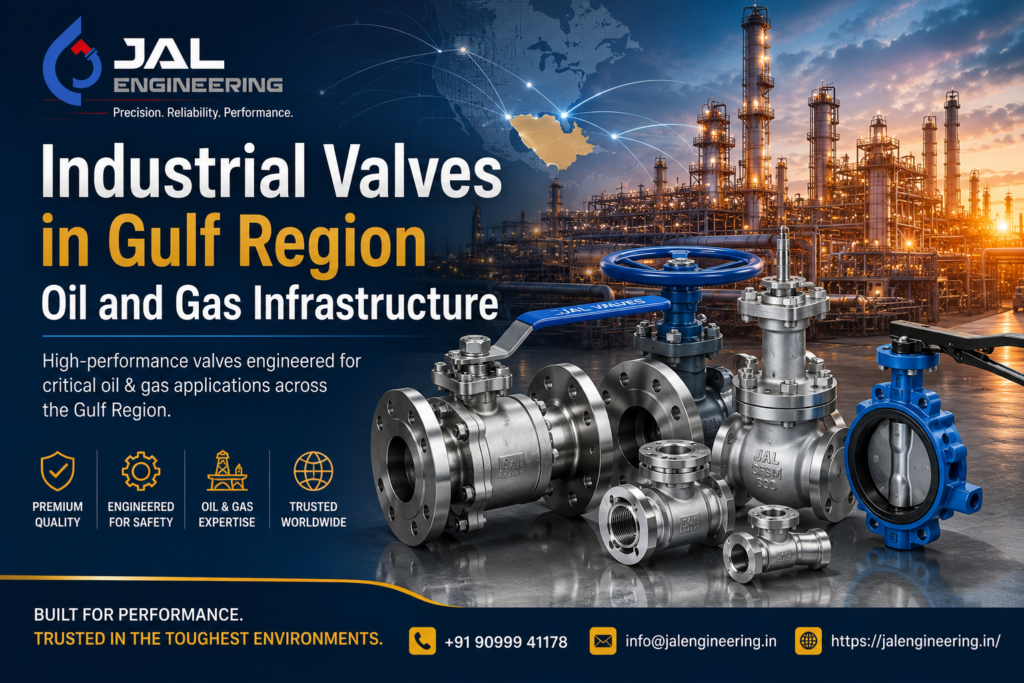
What Are Industrial Valves in Gulf Region Oil and Gas Infrastructure?
Industrial valves are the flow control backbone of Gulf region oil and gas infrastructure. They regulate, isolate, and direct hydrocarbons across upstream wells, midstream pipelines, and downstream refineries. In the GCC, where extreme heat, high pressure, and corrosive media are constant challenges, selecting API-certified, corrosion-resistant valves with smart monitoring capability is essential for safety, compliance, and operational continuity.
Introduction
Every barrel of crude oil extracted in Saudi Arabia, every cubic meter of LNG shipped from Qatar, and every refined product flowing through UAE pipelines depends on one often-overlooked component: the industrial valve.
Valves are not supporting actors in oil and gas operations. They are the gatekeepers. They control pressure, regulate flow, isolate hazardous media, and protect entire facilities from catastrophic failure. Yet when procurement teams face compressed timelines and cost pressures, valve selection is frequently rushed — with consequences that cost far more than any savings made.
The numbers reflect the stakes. The global industrial valves market in oil and gas was valued at USD 15.67 billion in 2024 and is estimated to reach USD 22.45 billion by 2033, growing at a CAGR of 4.5%. Within this landscape, the Gulf region punches well above its weight. Saudi Arabia, UAE, and Qatar lead in high-pressure valve installations, accounting for over 65% of regional demand. Offshore oilfields in the Persian Gulf use corrosion-resistant gate and ball valves in over 75% of their systems. Verified Market Reports Global Growth Insights
For procurement managers, plant engineers, EPC contractors, and refinery operators working in this region, understanding valve selection — the right type, the right material, the right certification, and increasingly, the right level of intelligence — is not a technical luxury. It is an operational imperative.
This guide delivers that understanding for 2026 and beyond.
Table of Contents
- Why Valves Are the Nervous System of Gulf Oil & Gas Operations
- The Gulf’s Unique Operating Environment: What Valves Must Withstand
- Key Valve Types Used Across Upstream, Midstream, and Downstream
- Material Selection for Extreme Desert and Offshore Conditions
- Valve Standards and Compliance in GCC Projects
- Real-World Applications: Country-by-Country Breakdown
- Traditional Valves vs Smart Valves: A 2026 Comparison
- IoT Integration and Predictive Maintenance in Valve Systems
- Emerging Valve Technologies in 2026
- Sustainability, Energy Efficiency, and the Future of Gulf Valve Systems
- Common Challenges and Proven Solutions
- Industry Expert Insights and Professional Recommendations
- Frequently Asked Questions
- Key Takeaways
- Conclusion
Why Valves Are the Nervous System of Gulf Oil & Gas Operations
The Gulf Cooperation Council (GCC) region — comprising Saudi Arabia, UAE, Qatar, Oman, Kuwait, and Bahrain — collectively holds some of the world’s most complex and high-value energy infrastructure. Oil fields, LNG terminals, petrochemical complexes, offshore platforms, and thousands of kilometers of pipelines form an interconnected system that supplies energy to global markets.
At every critical junction of this system, there is a valve.
Valves perform five fundamental functions in oil and gas operations:
- Isolation — Shutting off sections of pipelines or equipment for maintenance, emergency response, or process changes
- Flow regulation — Adjusting the volume and velocity of hydrocarbons passing through pipelines and process equipment
- Pressure control — Maintaining safe operating pressures within defined limits across all process stages
- Directional control — Preventing backflow and ensuring media travels through the correct pathways
- Emergency shutdown — Automatically isolating hazardous sections during process upsets or safety events
In 2024–2025, global oil demand averaged over 103 million barrels per day, while electricity generation capacity continued to expand across Asia-Pacific and the Middle East. These energy-intensive systems rely heavily on industrial valves to ensure safe, continuous, and efficient fluid regulation.
In the Gulf, this reliance is amplified by the scale and complexity of operations. Saudi Aramco alone operates the world’s largest integrated oil and gas infrastructure. ADNOC in the UAE manages offshore and onshore assets across multiple emirates. QatarEnergy controls one of the planet’s largest natural gas reserves. Every single facility in these networks depends on valves performing reliably — often in conditions that would destroy lesser equipment.
The Gulf’s Unique Operating Environment: What Valves Must Withstand
The Gulf region presents one of the harshest operating environments for industrial equipment anywhere on earth. Valves selected for European or North American conditions will frequently underperform or fail entirely when deployed in GCC oil and gas facilities.
Understanding these environmental challenges is the foundation of correct valve selection.
Extreme Heat and Thermal Cycling
Ambient temperatures in the Gulf regularly exceed 45°C in summer, with direct sun exposure raising surface temperatures on equipment to 65°C or higher. In downstream refinery and petrochemical processes, internal fluid temperatures can reach 350°C to 600°C. Valve bodies, seats, seals, and actuators must be engineered to handle not only sustained high temperatures but also significant thermal cycling between operational phases.
High-Pressure Service Conditions
Wellhead applications in Gulf upstream operations frequently operate at pressures exceeding 5,000 PSI. High-pressure gas transmission pipelines maintain operating pressures of 1,000 to 2,000 PSI. Even downstream refinery processes involve pressures that demand Class 600, 900, or 1500 ANSI-rated valve assemblies. Pressure ratings must be verified not only at ambient conditions but at maximum operating temperature, where material strength properties change significantly.
Corrosive Media and H₂S Service
Gulf crude oil streams frequently contain hydrogen sulfide (H₂S), carbon dioxide (CO₂), and chlorides — all aggressively corrosive to standard carbon steel. Offshore applications add seawater exposure and salt-laden atmospheric corrosion on external surfaces. Local equipment, including valves, is purpose-designed to meet high temperatures, combat corrosive saline exposure, and operate with minimal failure rates. This requires specific material grades and NACE MR0175 / ISO 15156 compliance for sour service.
Sand and Particulate Contamination
Desert environments generate fine silica sand particles that infiltrate actuator mechanisms, degrade valve seals, and cause premature wear in flow paths. Valves must incorporate appropriate filtration and protection to prevent particulate ingress into actuators and instrumentation.
High Cycling Frequency
Control valves in refinery operations may cycle thousands of times per day. Emergency shutdown valves must guarantee reliable operation even after extended periods without actuation. Both extremes demand mechanical designs built for longevity under demanding operational regimes.
Key Valve Types Used Across Upstream, Midstream, and Downstream
Different stages of oil and gas operations demand different valve solutions. Selecting the wrong valve type for a given application is one of the most common and costly procurement errors in the industry.
Upstream Applications: Wellheads and Gathering Systems
Gate Valves are the workhorse of upstream isolation. Their full-bore, bidirectional design allows unrestricted flow when open and complete isolation when closed. API 6A gate valves dominate wellhead applications where full bore access is required for pigging or intervention tools. Sizes from 2″ to 30″ are common in Gulf gathering systems.
Ball Valves provide rapid quarter-turn isolation and are preferred for applications where fast shut-off is critical. Ball valves dominated the industrial valve market in 2025 due to their simple design, tight shut-off capability, low maintenance requirements, and suitability for automation. Their ability to handle high pressure and temperature makes them the preferred choice for critical applications. In upstream Gulf operations, trunnion-mounted ball valves are specified for larger diameter and higher-pressure service. MAXIMIZE MARKET RESEARCH
Choke Valves are unique to upstream production. They control the flow rate from individual wells and must handle highly abrasive fluid mixtures of oil, gas, water, and sand. Tungsten carbide or ceramic trim is standard for extended service life in harsh well fluid conditions.
Midstream Applications: Pipelines and Compression Stations
Pig Trap Valves and Full-Bore Ball Valves accommodate pipeline inspection gauges (pigs) for internal inspection and cleaning runs. Gulf export pipelines — including major crude and gas lines across Saudi Arabia and the UAE — require full-bore API 6D certified ball valves that maintain bore continuity.
Check Valves prevent reversal of flow at compressor stations, pump discharge, and pipeline junctions. Swing check, tilting disc, and dual plate designs are selected based on pipeline diameter, flow velocity, and the consequences of reverse flow.
Pressure Relief and Safety Valves protect pipeline systems from overpressure events caused by thermal expansion, blocked outlets, or process upsets. API 526 and API 527 standards govern their selection and testing in Gulf midstream facilities.
Downstream Applications: Refineries and Petrochemical Plants
Globe Valves provide precise throttling control in refinery process streams where accurate flow regulation affects product quality. They are extensively used in heat exchanger bypass, steam systems, and cooling water circuits.
Butterfly Valves offer cost-effective large-diameter isolation in lower-pressure process streams. High-performance double-offset and triple-offset butterfly valves handle challenging process conditions in refinery and petrochemical service.
Control Valves are the most technologically sophisticated valve category in downstream operations. Control valves are critical in downstream processing, especially in refineries and petrochemical units. Demand is driven by the need for precise flow control in upstream production, midstream pipeline transmission, and downstream refining including catalytic cracking and distillation columns. IndexBox
Material Selection for Extreme Desert and Offshore Conditions
Material selection determines whether a valve delivers 25 years of reliable service or fails prematurely in Gulf conditions. There is no universal answer — the correct material depends on the specific combination of fluid composition, temperature, pressure, and environmental exposure.
Carbon Steel (ASTM A216 WCB / A105)
Carbon steel remains the baseline material for non-corrosive, moderate-temperature applications. It is cost-effective and widely available, but it is not suitable for sour service, chloride-containing media, or high-temperature steam service without appropriate surface treatment.
Stainless Steel (316 / 316L)
316L stainless steel is the minimum standard for seawater exposure, chloride-containing process streams, and many chemical service applications. Its molybdenum content provides substantially better pitting and crevice corrosion resistance than standard 304 grades.
Duplex and Super Duplex Stainless Steel (2205 / 2507)
Valves must be manufactured from Duplex SS, Inconel, Monel, Titanium, or corrosion-resistant alloys, depending on the medium. Duplex 2205 and Super Duplex 2507 deliver a compelling combination of high strength and exceptional corrosion resistance, making them the material of choice for offshore Gulf applications, high-chloride streams, and sour service. The higher yield strength compared to standard stainless steel also allows for more compact, lighter valve designs at the same pressure rating. Middle East Valve
Inconel and Monel Alloys
For the most severe service conditions — extreme temperatures combined with highly corrosive media — nickel-based alloys such as Inconel 625, Inconel 718, and Monel 400 are specified. These materials appear in subsea completions, high-pressure H₂S service, and certain catalyst-contaminated refinery streams.
Hard-Faced Trim Materials
Valve internal trim components — seats, balls, discs, and stems — are often hard-faced with Stellite (cobalt-chromium alloy), tungsten carbide, or ceramic coatings to resist erosion from abrasive fluid streams containing sand, catalyst fines, or solid particles.
Valve Standards and Compliance in GCC Projects
Any valve supplied to a major Gulf oil and gas project must satisfy a rigorous framework of international standards and owner-operator specifications. Procurement managers and EPC contractors who underestimate this requirement face costly rejection, schedule delays, and potential safety incidents.
International Standards That Matter
- API 6A — Wellhead and Christmas tree equipment, including gate valves and choke valves
- API 6D — Pipeline valves including ball valves, gate valves, plug valves, and check valves
- API 608 — Metal ball valves for petroleum, petrochemical, and natural gas industries
- ASME B16.34 — Valves flanged, threaded, and welding end, governing pressure-temperature ratings
- NACE MR0175 / ISO 15156 — Material requirements for equipment in H₂S-containing environments
Owner-Operator Specifications
Valves must meet the rigorous standards of Aramco, ADNOC, BAPCO, EGA, DEWA, Qatar Energy, KNPC, KOC, and Ma’aden, SABIC, SASREF, ensuring reliability in high-pressure and high-temperature applications. GCC Valves
Each major operator publishes its own supplementary technical specifications that go beyond international standards. Saudi Aramco’s SAES specifications, ADNOC’s DEP documents, and QatarEnergy’s technical standards all contain requirements for material certifications, testing protocols, documentation packages, and approved manufacturer lists. Suppliers must maintain active vendor qualification status with these operators to supply major projects.
Key documentation required for GCC valve procurement includes:
- Third-party inspection certificates (Bureau Veritas, Lloyd’s, SGS, Intertek, TÜV)
- Positive Material Identification (PMI) reports confirming alloy composition
- Hydrostatic and shell test certificates at 1.5× design pressure
- Low-temperature impact test results for carbon steel valves
- Quality Assurance Plans (QAP) and Inspection and Test Plans (ITP)
Real-World Applications: Country-by-Country Breakdown
Saudi Arabia — Aramco Jafurah Gas Field
Saudi Arabia represents the largest single valve market in the Gulf, driven by ongoing investment in oil field maintenance, expansion of the Jafurah unconventional gas development, and petrochemical complex upgrades at Jubail and Yanbu. Baker Hughes secured a major valve and actuator order for Saudi Aramco’s Jafurah gas field in January 2025, reflecting the scale of procurement activity in this program alone. Jafurah requires high-pressure gate valves, corrosion-resistant control valves, and emergency shutdown systems across thousands of wellheads and gathering lines. Saudi Arabia’s oil and gas industry alone invested more than $150 billion in 2024, creating a significant need for industrial valves, particularly for pressure management, flow control, and safety systems. Mordor Intelligence Verified Market Research
UAE — ADNOC Offshore and Desalination
The UAE presents a dual demand picture: massive oil and gas infrastructure operated by ADNOC on one hand, and rapidly expanding water desalination and smart city infrastructure on the other. Offshore platforms in the Arabian Gulf require subsea-rated valves in duplex and super duplex materials with cathodic protection compatibility. The UAE’s demand for industrial valves is predicted to grow by 20–25%, driven by large projects such as new water treatment plants and smart city expansions. ADNOC’s drive to increase crude production capacity from 4 million to 5 million barrels per day by 2027 will continue to generate substantial valve procurement requirements. Verified Market Research
Qatar — LNG Infrastructure at Scale
Qatar controls the world’s third-largest natural gas reserves and has long been the global leader in LNG production. Qatar Energy’s North Field expansion program — one of the largest LNG capacity additions in history — requires massive volumes of cryogenic valves, high-pressure ball valves, and fire-safe control valves to handle liquefied natural gas at -162°C. Qatar-related sourcing often centers on LNG-linked, gas, utility, and industrial package requirements where documentation responsiveness and local coordination matter as much as product breadth.
Oman — PDO and Block Development
Petroleum Development Oman (PDO) manages a mature yet expanding oil field portfolio. Enhanced oil recovery projects demand high-quality injection valves capable of handling steam, water, and gas under pressures that challenge standard designs. Oman’s Salalah and Duqm industrial zones are also driving increasing petrochemical valve requirements.
Kuwait — KNPC Refinery Modernization
Kuwait’s Clean Fuels Project — operated by Kuwait National Petroleum Company (KNPC) — represents one of the GCC’s most significant downstream modernization programs. The upgrade of the Mina Al Ahmadi and Mina Abdullah refineries has required thousands of control valves, globe valves, and butterfly valves optimized for Euro V-grade fuel production processes. Refinery operations in Kuwait have greatly benefited from high-performance ball and globe valves, where product quality and after-sales support are critical considerations. Middle East Valve
Bahrain — BAPCO Modernization Program
Bahrain Petroleum Company’s (BAPCO) Sitra refinery modernization program is the most ambitious single-site downstream project in the country’s history. The project requires API-compliant valves across a wide service range — from crude distillation units requiring high-temperature globe valves to hydrogen service applications demanding special alloy gate valves with enhanced sealing systems.
Traditional Valves vs Smart Valves: A 2026 Comparison
The Gulf oil and gas sector is navigating a fundamental technology transition in valve systems. Understanding the capabilities, limitations, and economics of smart valves versus traditional mechanical valves is essential for any procurement or engineering decision made in 2026.
| Feature | Traditional Valves | Smart Valves (IoT-Enabled) |
|---|---|---|
| Condition Monitoring | Manual inspection on schedule | Continuous real-time sensor data |
| Failure Detection | After failure occurs | Predictive — before failure |
| Maintenance Approach | Time-based preventive maintenance | Condition-based predictive maintenance |
| Actuator Feedback | Position switches only | Full diagnostic stroke data |
| Integration | Manual SCADA input | Native SCADA / DCS / IIoT integration |
| Leak Detection | Physical inspection | Acoustic sensors detect micro-leaks |
| Data Output | None | Continuous telemetry to control systems |
| Initial Cost | Lower | 20–40% premium |
| Lifetime Operating Cost | Higher (more maintenance events) | Lower (reduced unplanned downtime) |
| Remote Operability | Limited | Full remote operation capability |
| Suitability for Remote Sites | Moderate (requires personnel visits) | High (reduces personnel requirements) |
| Regulatory Compliance | Manual records required | Automatic audit trails |
The economic case for smart valves strengthens significantly in high-value, safety-critical, or remote applications where unplanned downtime costs are severe. A single unplanned shutdown in a Gulf refinery can cost between $500,000 and $2 million per day in lost production alone. Smart valves that prevent even one such event per year deliver returns that substantially exceed their premium acquisition cost.
IoT Integration and Predictive Maintenance in Valve Systems
The digitalization of Gulf oil and gas operations is accelerating. Smart valve technology is no longer a future aspiration — it is an active procurement requirement on major GCC projects in 2026.
The trend toward digital oilfields and remote operations is accelerating the adoption of smart valves with embedded sensors and IIoT connectivity, enabling real-time monitoring and predictive maintenance. The sector will see steady demand from brownfield modernization projects in the Middle East. IndexBox
Modern smart valve systems typically incorporate:
Intelligent Valve Positioners that continuously measure valve position, applied torque, and actuator pressure, comparing actual versus commanded behavior to identify developing faults before they cause failure.
Acoustic Emission Sensors that detect the characteristic sound signatures of seat leakage, cavitation, and flashing — identifying problems that are completely invisible to traditional inspection methods.
Vibration Monitoring that flags excessive stem packing wear, bearing degradation, or actuator mechanical issues based on changes in vibration signature over time.
Temperature Sensors monitoring both fluid temperature and actuator temperature to detect thermal anomalies that could indicate developing problems or confirm correct valve insulation performance.
Integration with SCADA and DCS platforms through standard industrial protocols including HART, Foundation Fieldbus, PROFIBUS, and increasingly OPC-UA for IIoT connectivity.
Sensor-integrated ball and control valves feed operational data into SCADA and DCS platforms, allowing operators to monitor conditions continuously. Companies like Emerson with Fisher digital valve systems and Flowserve with Logix smart positioners are deploying connected valve solutions to reduce unplanned shutdowns and energy losses. Coherent Market Insights
IMI plc reduced unplanned shutdowns by up to 20% by targeting smart, IoT-enabled valve applications. For Gulf operators managing facilities where production rates are measured in hundreds of thousands of barrels per day, this level of reliability improvement translates into measurable financial benefit. MAXIMIZE MARKET RESEARCH
Emerging Valve Technologies in 2026
Autonomous Inflow Control Valves
A significant technological development in upstream Gulf operations is the deployment of autonomous inflow control valves (AICVs) in horizontal and multilateral wells. In January 2025, Inflow Control introduced the Gas Autonomous Inflow Control Valve (Gas AICV), marking a significant advancement in gas reservoir management. This technology enables efficient gas production by autonomously managing water breakthrough, maintaining reliable and stable production while improving profitability for operators. Coherent Market Insights
In the context of mature Gulf oil fields where water cut management is critical to sustaining production economics, autonomous inflow control technology offers operators a passive, downhole solution that improves recovery without the complexity and cost of active intervention.
Hydrogen-Ready Valve Designs
As Gulf states advance their clean energy and green hydrogen ambitions — Saudi Arabia’s NEOM project, UAE’s hydrogen export strategy, and Oman’s growing hydrogen sector — valve manufacturers are developing designs specifically qualified for hydrogen service. Hydrogen presents unique challenges: very small molecular size promotes permeation through metal microstructure, embrittlement risk in high-strength materials, and highly flammable leak potential. Emerson Electric completed the first shipment of HV-7000 hydrogen regulators for a Gulf Coast pilot pipeline in January 2026, reflecting the pace of technology development in this space. Mordor Intelligence
Digital Twin Integration
Leading valve manufacturers now offer digital twin capabilities that create virtual replicas of physical valve assets. These models allow engineers to simulate valve behavior under different process conditions before physical changes are made, optimize control valve sizing without physical testing, and predict remaining service life based on operational history.
Subsea Valve Innovation
Qatar and UAE’s offshore deepwater ambitions are driving demand for subsea isolation valves and actuator systems capable of operating reliably at depths exceeding 500 meters, where maintenance access is extremely limited and reliability requirements are correspondingly elevated.
Sustainability, Energy Efficiency, and the Future of Gulf Valve Systems
The Gulf oil and gas sector faces increasing pressure to reduce its own operational carbon footprint while continuing to supply global energy markets. Industrial valve technology is a meaningful contributor to this effort.
Fugitive Emissions Reduction is a priority across Gulf operations following strengthened regulatory requirements. Low-emission (LE) valve stem packing designs, tested to ISO 15848-1 standards, minimize volatile organic compound (VOC) leakage from valve stems — a significant source of facility-level methane and hydrocarbon emissions.
Control Valve Efficiency directly impacts energy consumption in pump and compressor systems. A correctly sized control valve with optimized trim operates with lower pressure drop, reducing the energy required by pumping or compression systems to maintain the desired flow rate. In a large refinery operating hundreds of control valves, aggregate energy savings from proper valve sizing and maintenance can be substantial.
Process Optimization through Smart Valves allows operators to maintain tighter control around optimal process conditions, reducing energy consumption in distillation, heat exchange, and reaction systems by minimizing deviations from setpoint.
Over 45% of new investments are directed toward valve automation and smart technologies in the Gulf region, reflecting operator recognition that intelligent valve systems are central to both operational efficiency and sustainability objectives. Global Growth Insights
Common Challenges and Proven Solutions
Challenge 1: Valve Seat Leakage in High-Differential-Pressure Service
Many Gulf refineries experience premature seat leakage in gate and ball valves exposed to high-pressure differentials combined with sand or catalyst particle contamination.
Solution: Specify hard-faced seats (Stellite 6 or tungsten carbide) for abrasive service. Implement upstream strainers to reduce particle load. Specify reduced-port ball valves for throttling applications rather than using full-bore designs in partially open positions.
Challenge 2: Actuator Failure in Extreme Heat
Pneumatic actuator diaphragms and seals degrade rapidly when ambient temperatures exceed 60°C during Gulf summers, particularly when actuators are exposed to direct sunlight.
Solution: Specify actuators with high-temperature elastomers (EPDM or PTFE) rated for ambient conditions. Provide sun shades or insulated enclosures for actuators on exposed equipment. Consider electric actuators for locations where compressed air quality or supply reliability is an issue.
Challenge 3: Corrosion Under Insulation (CUI)
Valves in insulated pipeline systems across Gulf facilities are particularly susceptible to external corrosion beneath insulation, which is accelerated by cyclic temperature service that draws in moisture.
Solution: Apply appropriate corrosion-resistant external coatings before insulation installation. Specify stainless steel or alloy valve bodies in CUI-susceptible locations. Implement inspection programs using pulsed eddy current (PEC) technology to detect CUI without insulation removal.
Challenge 4: Legacy System Integration for Smart Valves
Over 35% of midstream pipelines still operate with analog control systems, limiting compatibility with digital valves. Nearly 25% of installation errors stem from inadequate training, increasing operational risk. Global Growth Insights
Solution: Implement HART-protocol intelligent positioners as a first step — HART communicates over existing 4-20mA wiring, allowing smart diagnostics without full system replacement. Develop site-specific training programs for maintenance teams. Consider phased smart valve implementation starting with highest-criticality assets.
Challenge 5: Procurement Documentation Compliance
GCC projects have demanding documentation requirements that many international valve suppliers struggle to fulfill on schedule, causing delivery delays on critical path items.
Solution: Qualify valve suppliers early in the project cycle, specifically evaluating their documentation management systems and historic delivery performance on GCC projects. Require ITP and QAP submission and approval before material fabrication commences. Build documentation review milestones into the project schedule.
Industry Expert Insights
On Material Specification: When specifying valve materials for Gulf sour service, do not rely on generic NACE compliance — confirm that the specific material heat and manufacturing process meet the hardness limits in MR0175 Table A.2. A technically non-compliant valve that passes mill certificates superficially can cause sulfide stress cracking failures months after commissioning, with safety and production consequences that dwarf the original valve cost.
On Smart Valve Implementation: The commercial case for smart valves depends heavily on accurately quantifying your current unplanned maintenance cost. Before specifying IoT-enabled valves at premium cost, instrument your current failure history. In most Gulf refineries that do this analysis properly, the business case for smart valves on critical control and emergency shutdown service becomes overwhelming.
On Valve Sizing for Control Service: The single most common sizing error in control valve specification is selecting valves based on line size rather than the actual required Cv range. A control valve operating below 20% or above 80% of its travel range is being misapplied. Correct sizing — frequently one size smaller than the connecting pipe — delivers dramatically better control performance and extended trim life.
On Supplier Qualification: Approved Vendor List (AVL) status with major operators like Saudi Aramco, ADNOC, and QatarEnergy is not simply a commercial credential — it reflects demonstrated manufacturing quality, engineering capability, and after-sales support infrastructure. On safety-critical valve applications, restricting procurement to AVL-approved suppliers is not bureaucratic caution. It is fundamental risk management.
Frequently Asked Questions
Q1: What are the most important valve types used in Gulf oil and gas operations?
The most critical valve types for Gulf oil and gas operations are gate valves for pipeline isolation, ball valves for rapid shut-off, globe valves for precise flow control, check valves for backflow prevention, control valves for process regulation, and emergency shutdown valves for safety. Valve selection depends on the specific application — upstream, midstream, or downstream — and the process conditions involved.
Q2: What certifications must industrial valves have for Saudi Aramco or ADNOC projects?
Valves for Saudi Aramco projects must comply with SAES engineering standards and are typically required to meet API 6A, API 6D, or API 608 as applicable, with third-party inspection certificates from approved bodies. ADNOC projects follow similar requirements based on ASME B16.34 and DEP specifications. Both operators maintain approved manufacturer lists, and suppliers must achieve and maintain active qualification status.
Q3: Why is duplex stainless steel preferred for offshore Gulf valve applications?
Duplex and super duplex stainless steels offer a combination of high strength and excellent corrosion resistance that makes them ideal for offshore Gulf applications. Their resistance to pitting, crevice corrosion, and chloride stress corrosion cracking in seawater environments significantly outperforms standard 316L stainless steel. The higher strength also allows for more compact and lighter valve designs at equivalent pressure ratings.
Q4: What is the difference between NACE MR0175 and ISO 15156 compliance for valves?
NACE MR0175 and ISO 15156 are technically equivalent standards — ISO 15156 was adopted as the international version of the NACE standard. Both specify material requirements for equipment used in oil and gas production environments containing H₂S. Compliance ensures that valve materials are resistant to sulfide stress cracking and hydrogen-induced cracking in sour service conditions.
Q5: How do smart valves reduce maintenance costs in Gulf refineries?
Smart valves with intelligent positioners and diagnostic sensors continuously monitor their own performance, detecting developing issues such as seat leakage, stem packing wear, and actuator degradation before these cause failure. This enables condition-based maintenance — replacing or repairing components when diagnostics indicate the need, rather than on a fixed calendar schedule. The result is reduced unnecessary maintenance interventions and prevention of unplanned failures that cause costly production interruptions.
Q6: What valve materials are required for LNG service in Qatar’s export terminals?
LNG service at cryogenic temperatures down to -162°C requires materials that maintain ductility and fracture toughness at extremely low temperatures. Austenitic stainless steels (316L, 304L), 9% nickel steel for large diameter applications, and aluminum alloys for certain applications are standard. Valve bodies, trim, and seat materials must all be impact tested at design minimum temperature to confirm adequate toughness.
Q7: How should procurement managers evaluate valve suppliers for GCC oil and gas projects?
Key evaluation criteria for Gulf valve procurement include: active qualification status on operator approved vendor lists; demonstrated experience with the specific valve type and service conditions; third-party inspection capability and track record; documentation management systems for ITP, QAP, and certification packages; regional presence for technical support and field service; and references from comparable GCC projects. Price should not be the primary selection criterion for safety-critical or high-consequence valve applications.
Q8: What are emergency shutdown valves and why are they critical for offshore Gulf platforms?
Emergency shutdown (ESD) valves are fail-safe automated valves that close automatically upon detection of a process upset, fire, gas release, or other emergency condition. They isolate hazardous sections of process systems to prevent escalation. On offshore Gulf platforms, ESD valves must meet SIL (Safety Integrity Level) requirements, typically SIL 2 or SIL 3 for critical applications, and must be proof-tested on a defined schedule to confirm their reliability. The consequences of ESD valve failure to operate on demand — in the worst case — include major fires, explosions, and loss of life.
Q9: How does valve selection affect energy efficiency in Gulf refinery operations?
Properly selected and maintained control valves minimize pressure drop losses in pump and compressor circuits, directly reducing electrical and fuel consumption. A control valve with correctly sized trim operating in the 40–80% travel range delivers stable control with minimum energy consumption. Oversized valves operating near closed position create excessive pressure drop and poor controllability. In large refineries, the cumulative energy impact of correct versus incorrect control valve sizing across hundreds of loops is significant.
Q10: What is the outlook for industrial valve demand in the Gulf region through 2030?
The Gulf valve market outlook is strongly positive through 2030. The Middle East is anticipated to post the fastest regional CAGR at 4.76% to 2031 in the oil and gas valve market. Drivers include continued investment in oil production capacity, major LNG expansion programs in Qatar, refinery modernization projects in Kuwait and Bahrain, UAE’s ADNOC production targets, and growing demand for desalination and petrochemical infrastructure across the region. Smart valve and automation requirements will grow disproportionately as operators prioritize digital oilfield programs.
About Jal Engineering — Trusted Industrial Valve Supplier for Oil & Gas Projects
When it comes to sourcing high-performance industrial valves for Gulf region oil and gas infrastructure, Jal Engineering stands as a trusted and reliable industrial valve manufacturer and supplier in India. With deep expertise in supplying API-certified valves, corrosion-resistant valves, high-pressure valves, and application-specific valve solutions — including gate valves, ball valves, globe valves, butterfly valves, check valves, control valves, and emergency shutdown valves (ESDVs) — Jal Engineering understands the demanding technical, material, and documentation requirements of GCC oil and gas projects.
Whether you are an EPC contractor sourcing API 6D certified pipeline valves for a Saudi Aramco-approved project, a procurement manager specifying duplex stainless steel valves for an offshore UAE platform, a refinery operator in need of NACE MR0175 compliant sour-service valves for a Kuwait or Qatar refinery, or a plant engineer looking for smart valves and IoT-enabled control valves for downstream petrochemical applications — Jal Engineering delivers the right product, the right certification, and the right technical support.
As a leading industrial valve exporter to the Middle East, Jal Engineering supplies ASME B16.34 rated valves, fire-safe valves, cryogenic valves for LNG service, and high-temperature valves for refinery applications — all backed by full third-party inspection certificates, PMI reports, hydrostatic test certificates, and complete QAP and ITP documentation as required by major GCC operators including ADNOC, Qatar Energy, KNPC, BAPCO, and PDO.
Explore the complete range of industrial valve solutions for oil and gas, petrochemical, and pipeline applications at jalengineering.in and connect with their expert technical team today to discuss your valve procurement requirements for your next Gulf region project.