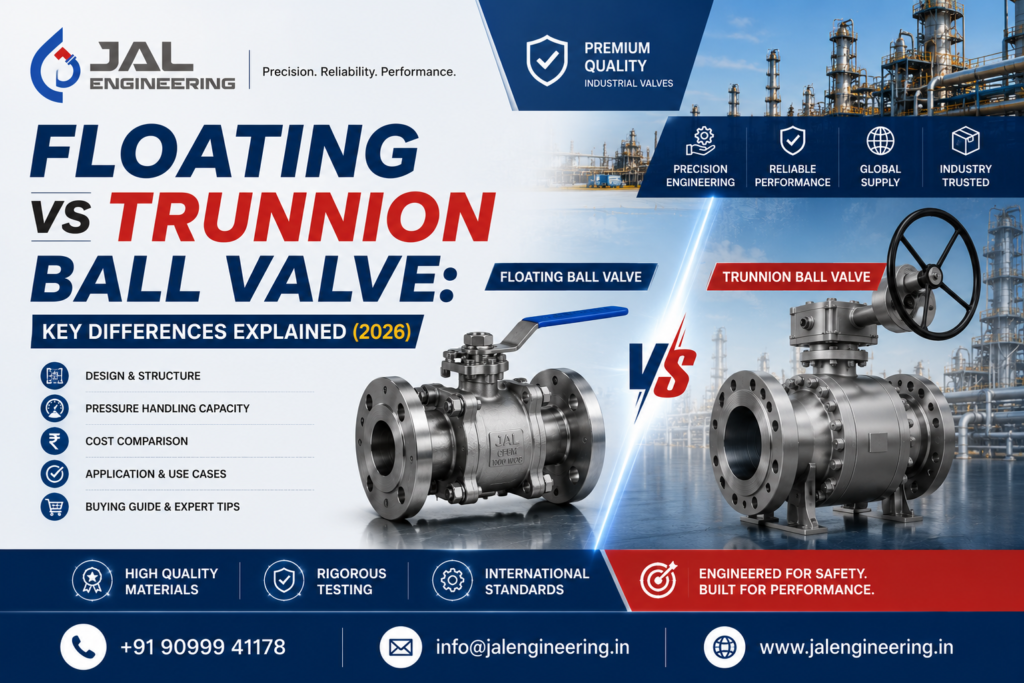
A floating ball valve has a ball that shifts slightly downstream under pressure to seal against the seat, making it ideal for low-to-medium pressure lines up to 2″ or Class 600, while a trunnion mounted ball valve has the ball fixed in place by top and bottom shafts (trunnions), making it suitable for high-pressure, large-diameter pipelines above Class 600 where the floating design would wear out too fast.
Choosing between a floating and trunnion ball valve is one of the most common decisions engineers and procurement teams face when specifying valves for a pipeline. Picking the wrong type leads to premature seat wear, leakage, or unnecessary overspending. This guide compares both designs so you can match the right valve to your application.
Last updated: July 2026
What Is a Floating Ball Valve?
In a floating ball valve, the ball is not fixed to a shaft at the bottom — it “floats” freely inside the valve body, supported only by the two seats. When the valve is closed and the line is pressurized, the upstream pressure pushes the ball slightly toward the downstream seat, creating a tight, self-energized seal.
Key characteristics:
- Simple construction with fewer components
- Lower manufacturing cost
- Compact and lightweight
- Self-adjusting sealing — no separate mechanism needed
- Best suited for sizes up to 2″ (though available up to 4-6″ in some designs)
What Is a Trunnion Mounted Ball Valve?
In a trunnion mounted ball valve, the ball is held in place by two shafts (trunnions) — one at the top connected to the stem, and one at the bottom supported by a bearing. Because the ball itself does not move, spring-loaded seats are used to maintain a constant sealing force against the ball, independent of line pressure.
Key characteristics:
- Ball is mechanically fixed, reducing stem and seat load
- Handles higher pressure and larger pipe diameters reliably
- Lower operating torque, even in large sizes
- More components, so generally more expensive
- Preferred for high-pressure oil & gas, and large-bore process lines
Floating vs Trunnion Ball Valve: Side-by-Side Comparison
| Parameter | Floating Ball Valve | Trunnion Mounted Ball Valve |
|---|---|---|
| Ball Support | Free-floating, seat-supported | Fixed by top & bottom trunnions |
| Sealing Mechanism | Pressure pushes ball onto seat | Spring-loaded seats press onto fixed ball |
| Typical Size Range | 1/4″ to 4″ | 2″ to 48″+ |
| Pressure Rating | Up to Class 600 (typically) | Class 600 to Class 2500+ |
| Operating Torque | Increases sharply with size/pressure | Remains manageable even at large sizes |
| Cost | Lower | Higher (more parts, precision machining) |
| Maintenance | Simple, fewer parts to service | More complex, but seats are replaceable independently |
| Best Applications | Utility lines, chemical dosing, general industrial use | Oil & gas pipelines, high-pressure steam, large process lines |
Which One Should You Choose?
Use this quick decision guide:
- Choose a floating ball valve if: your line size is small (under 3-4″), pressure is moderate (up to Class 600), and budget is a priority.
- Choose a trunnion mounted ball valve if: you’re working with large diameters, high pressure (above Class 600), or applications like cross-country pipelines, refineries, or high-pressure steam lines where torque and seat wear are critical concerns.
- When in doubt, check your P&ID pressure-temperature rating first — this single spec usually eliminates one of the two options immediately.
Material and Standards (Applicable to Both Types)
Both floating and trunnion ball valves are commonly manufactured in:
- SS304 / SS316 / SS316L for corrosion-resistant industrial and chemical applications
- Carbon Steel (WCB) for standard oil, gas, and utility applications
- Duplex/Super Duplex for high-chloride or offshore environments
Regardless of type, always verify:
- ASME/ANSI B16.34 pressure-temperature compliance
- API 6D or API 608 certification for oil & gas use
- Mill Test Certificates (MTC) for the specific raw material batch
- Fire-safe design (API 607) if required for your plant’s safety standards
Manufacturing Both Types: JAL Engineering
JAL Engineering, based in Ahmedabad, manufactures both floating and trunnion mounted ball valves in SS304, SS316, and SS316L grades, in 2-piece, 3-piece, flanged, and threaded configurations, with pressure ratings up to Class 800. Our team can help you select the right design based on your line size, pressure rating, and application before you place an order.
Get expert help choosing the right valve →
Frequently Asked Questions
Q1. What is the main difference between floating and trunnion ball valves? The main difference is how the ball is supported: in a floating ball valve, the ball moves slightly to seal against the seat under line pressure, while in a trunnion mounted ball valve, the ball is mechanically fixed and spring-loaded seats create the seal instead.
Q2. Is a trunnion ball valve better than a floating ball valve? Neither is universally “better” — a trunnion ball valve is better suited for high-pressure, large-diameter pipelines, while a floating ball valve is more cost-effective and sufficient for smaller, lower-pressure applications.
Q3. At what size should I switch from floating to trunnion ball valves? Most engineers switch to trunnion mounted designs above 4″ or when the pressure class exceeds 600, since operating torque and seat wear become harder to manage with a floating design at that scale.
Q4. Can floating ball valves handle high pressure? Floating ball valves can handle moderate-to-high pressure in smaller sizes, but as size increases, the torque required to seal against the pressure-loaded seat becomes impractical, which is why trunnion designs take over for large, high-pressure lines.
Q5. Which valve type is used in oil and gas pipelines? Trunnion mounted ball valves are the standard choice for oil and gas pipelines because they reliably handle high pressure, large diameters, and frequent cycling without excessive seat wear.
Q6. Do both valve types come in stainless steel? Yes, both floating and trunnion mounted ball valves are available in SS304, SS316, and SS316L, which are commonly specified for chemical, pharmaceutical, and export-grade industrial applications.
Need help selecting between a floating or trunnion ball valve for your project? Contact JAL Engineering for a technical recommendation and quote.