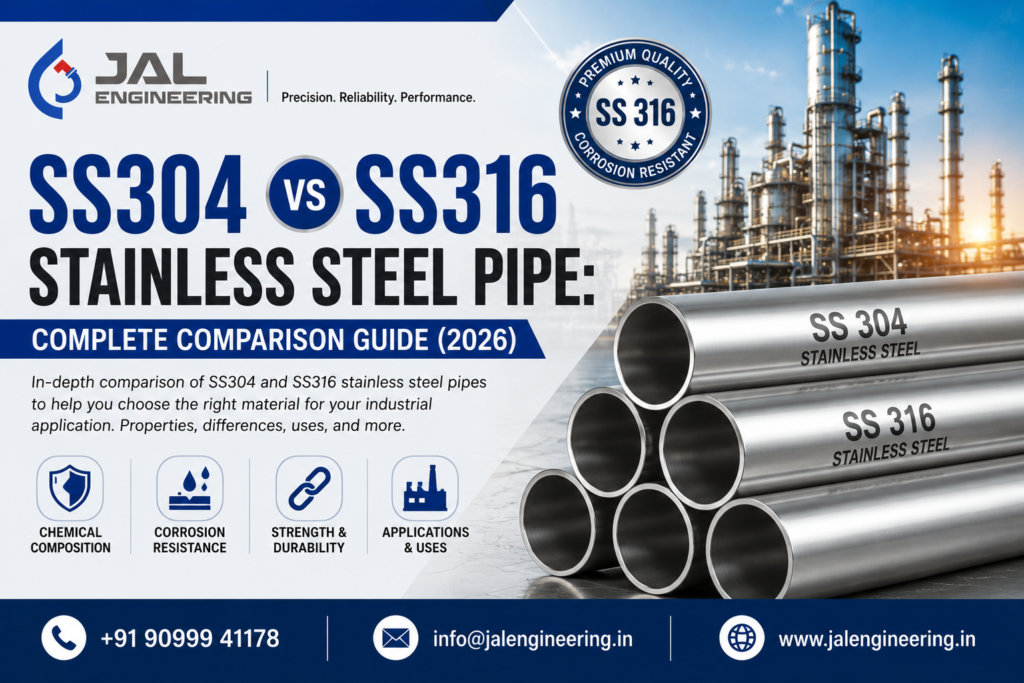
SS304 and SS316 are both austenitic stainless steel grades, but SS316 contains 2–3% molybdenum, which SS304 lacks. This makes SS316 significantly more resistant to chloride, saltwater, and chemical corrosion, while SS304 is more cost-effective and suitable for general industrial, food, and architectural use. If your application involves marine environments, chemical processing, or pharmaceutical use, choose SS316. For general piping, structural, and food-grade use where budget matters, SS304 is usually sufficient.
Introduction
Choosing between SS304 and SS316 stainless steel pipe is one of the most common decisions industrial buyers, contractors, and procurement engineers face — and getting it wrong can mean premature corrosion, costly replacements, or an unnecessarily inflated project budget. Both grades look identical, machine similarly, and are widely available, which is exactly why the wrong choice happens so often.
This guide breaks down the real differences between SS304 and SS316 pipes — composition, mechanical properties, corrosion resistance, pricing, and which industries should use which — so you can make a confident, informed decision.
SS304 vs SS316: Composition Comparison
| Property | SS304 | SS316 |
|---|---|---|
| Chromium (Cr) | 18–20% | 16–18% |
| Nickel (Ni) | 8–10.5% | 10–14% |
| Molybdenum (Mo) | None | 2–3% |
| Carbon (C) | ≤ 0.08% | ≤ 0.08% |
| Standard | ASTM A312 / A213 | ASTM A312 / A213 |
| Common Grade Names | SS304, 304L | SS316, 316L |
The presence of molybdenum in SS316 is the single biggest difference — it’s what gives this grade superior resistance to pitting and crevice corrosion, especially in chloride-rich environments like seawater, brine, and certain acids.
Corrosion Resistance: The Key Deciding Factor
| Environment | SS304 Performance | SS316 Performance |
|---|---|---|
| Freshwater / general atmosphere | Excellent | Excellent |
| Saltwater / marine / coastal | Moderate — can pit over time | Excellent |
| Chemical processing (acids, chlorides) | Poor to Moderate | Excellent |
| Food & beverage processing | Excellent | Excellent |
| Pharmaceutical & medical | Good | Excellent (preferred) |
| High-temperature applications | Good up to 870°C | Good up to 870°C |
Bottom line: If chlorides, salt exposure, or aggressive chemicals are part of the environment, SS316 pays for itself in reduced maintenance and replacement costs.
Mechanical Properties Comparison
| Property | SS304 | SS316 |
|---|---|---|
| Tensile Strength | 515 MPa (min) | 515 MPa (min) |
| Yield Strength | 205 MPa (min) | 205 MPa (min) |
| Elongation | 40% | 40% |
| Hardness (Brinell) | 201 HB max | 217 HB max |
| Weldability | Excellent | Excellent |
| Machinability | Good | Slightly harder to machine |
Mechanically, both grades perform similarly — the real differentiator is corrosion resistance and the environment the pipe will operate in, not strength.
Cost Comparison: Is SS316 Worth the Extra Price?
SS316 pipe typically costs 15–25% more than SS304 due to the added molybdenum and nickel content. For budget-sensitive projects without chemical or marine exposure, this premium isn’t justified. But for applications where corrosion failure means costly downtime — chemical plants, offshore equipment, pharma-grade piping — the higher upfront cost of SS316 is almost always cheaper than repeated SS304 replacements or failures.
Rule of thumb: Don’t choose based on price alone — choose based on total cost of ownership, factoring in expected service life and maintenance.
Which Grade Should You Choose? Industry-Wise Recommendations
| Industry / Application | Recommended Grade |
|---|---|
| Food & beverage processing | SS304 |
| Dairy equipment & piping | SS304 (or SS316 for acidic products) |
| Chemical & petrochemical plants | SS316 |
| Marine & offshore piping | SS316 |
| Pharmaceutical manufacturing | SS316 |
| Architectural & structural piping | SS304 |
| Water treatment plants | SS304 (SS316 for high-chloride water) |
| Oil & gas (onshore) | SS304 / SS316 depending on media |
| Coastal construction projects | SS316 |
Frequently Asked Questions
Q1. Can SS304 pipe be used in place of SS316? Yes, for general industrial, food-grade, and freshwater applications SS304 works fine. It should not be substituted in chloride-heavy or aggressive chemical environments, as it’s more prone to pitting corrosion.
Q2. Is SS316 always better than SS304? Not necessarily “better” — SS316 offers superior corrosion resistance but at a higher cost. For applications without chemical or saltwater exposure, SS304 offers the same mechanical strength at a lower price.
Q3. What is the difference between SS316 and SS316L? SS316L has a lower carbon content (≤0.03% vs ≤0.08%), which reduces the risk of carbide precipitation during welding. SS316L is preferred for welded pipe applications and pharmaceutical use.
Q4. Does SS304 rust? SS304 doesn’t rust in normal atmospheric conditions, but it can develop surface pitting or staining when exposed to chlorides (like salt) over time, unlike SS316 which resists this much longer.
Q5. Which grade is used in the pharmaceutical industry? SS316L is the industry standard for pharmaceutical and biotech piping due to its superior corrosion resistance and lower carbon content, which reduces contamination risk.
Need Help Choosing the Right Grade for Your Project?
At JAL Engineering, we manufacture and supply both SS304 and SS316 stainless steel pipes as per ASTM A312 / A213 standards, in seamless and welded construction, across all standard sizes and schedules. Our team can help you select the right grade based on your application, media, and budget — whether it’s a domestic project or a bulk export order.
Get a Quote | View SS Pipes Category