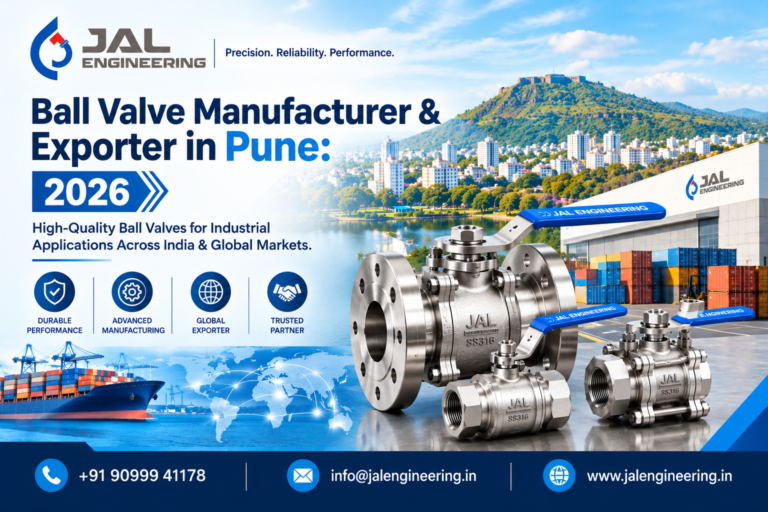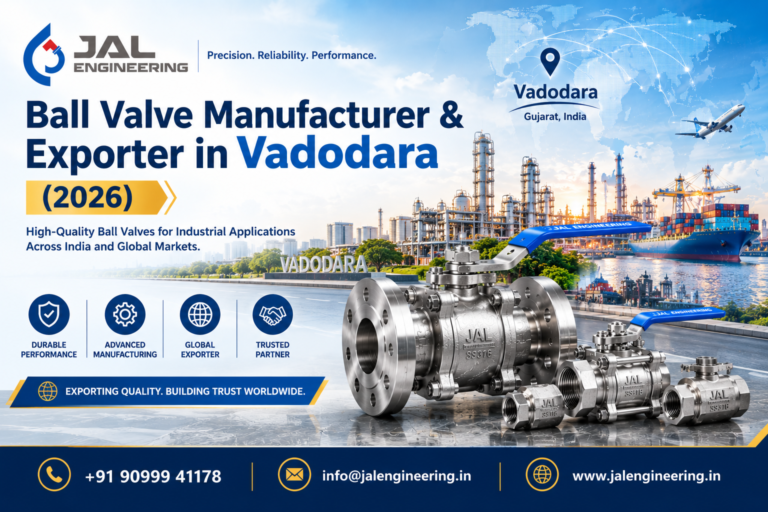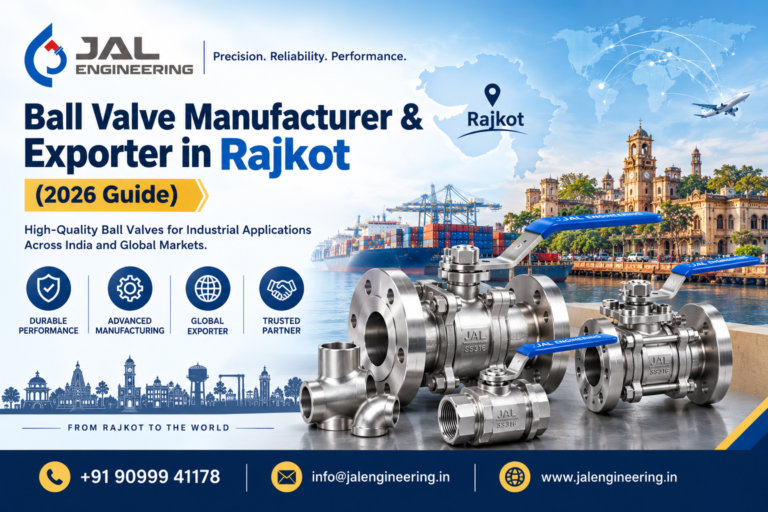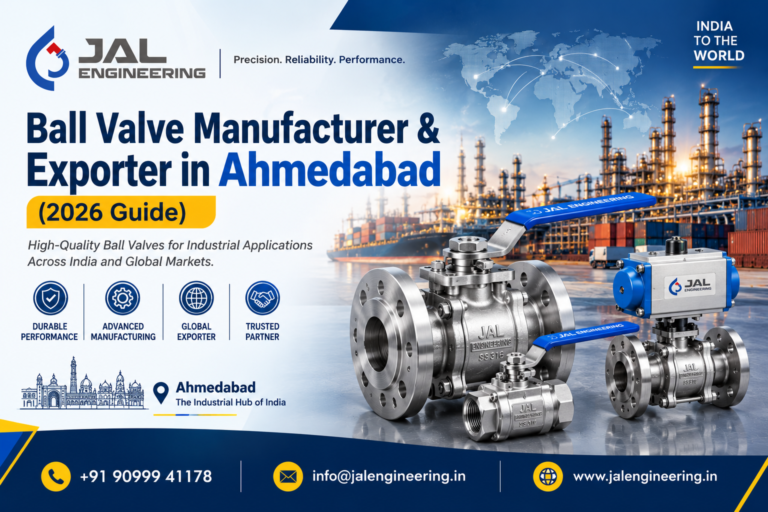
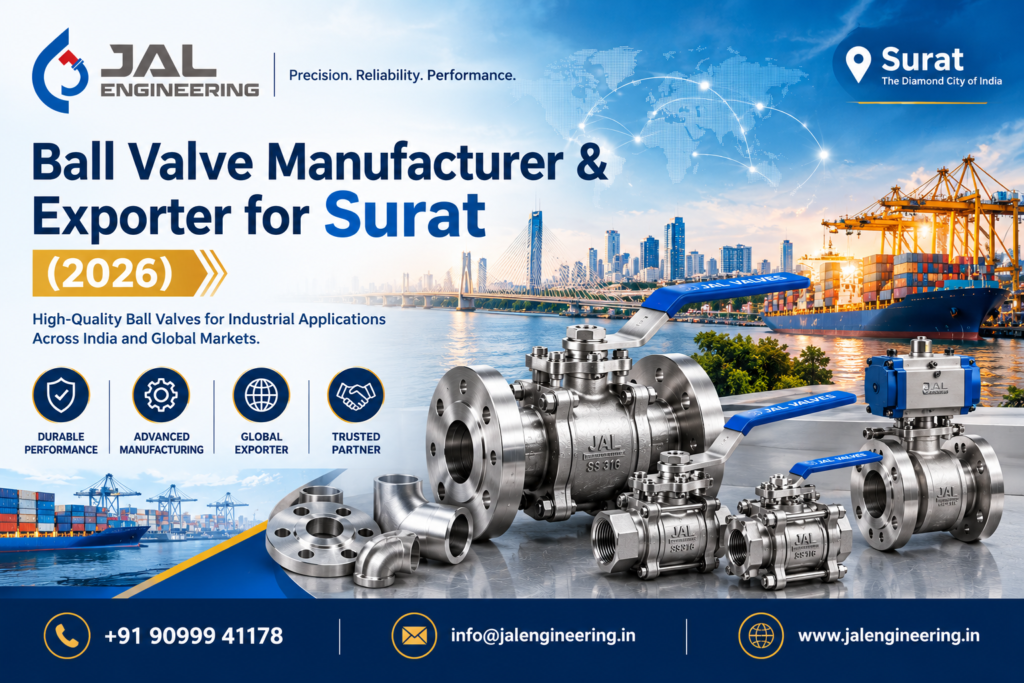
JAL Engineering is a ball valve manufacturer & exporter serving Surat from our Ahmedabad facility, about 270km away via NH48. We produce SS304, SS316, and SS316L ball valves in sizes NB 15mm to NB 600mm, rated up to Class 300/PN40, built to ANSI B16.34 and API 608. We supply Surat’s textile dyeing units, chemical plants, and EPC contractors directly, and we export to 60+ countries under an ISO 9001-compliant system.
If you run procurement for a dyeing unit in Pandesara, a chemical plant in Sachin GIDC, or an EPC project near Hazira, you already know the frustration: local trading shops that stock only floating valves in SS304, with no real technical backup when your process needs SS316L or a trunnion design. This guide covers what to check before you place an order — grades, pressure classes, standards, and realistic 2026 pricing — so you don’t find out the valve is wrong after it’s already installed.
In our two decades of manufacturing stainless steel fittings and valves out of Ahmedabad, we’ve supplied plenty of buyers in Surat’s textile and chemical corridor. The recurring problem we see isn’t availability — it’s mismatched specs. A valve rated for water service ends up on a dye-bath line, or a Class 150 valve goes where the piping spec calls for Class 300. This guide exists to help you avoid that.
Table of Contents
- Why Surat Buyers Source Ball Valves from Ahmedabad
- Ball Valve Types We Manufacture
- Material Grades: SS304 vs SS316 vs SS316L
- Pressure Classes & Size Range
- Ball Valve vs Gate Valve vs Butterfly Valve
- Standards & Testing
- Pricing & Lead Times in 2026
- Export Capability — Serving 60+ Countries
- Choosing the Right Ball Valve: A Selection Checklist
- FAQs
Why Surat Buyers Source Ball Valves from Ahmedabad
Surat runs on textile dyeing and printing, petrochemicals near Hazira, and a dense cluster of GIDC estates at Sachin, Pandesara, and Palsana. That mix creates steady demand for corrosion-resistant valves, but Surat’s own manufacturing base leans toward textile machinery and diamond processing, not valve casting and machining.
Ahmedabad fills that gap. At roughly 270km via NH48, a valve order from our Ahmedabad plant typically reaches Surat by road within a day. That’s fast enough for most planned maintenance and EPC schedules, and it means you get factory-direct pricing and technical support instead of paying a trading margin with no engineering backup behind it. For buyers who also need broader Gujarat coverage, our team already supports projects across the state, including industrial product supply in Rajasthan and neighbouring regions.
Ball Valve Types We Manufacture
We manufacture floating ball valves, trunnion-mounted ball valves, three-piece ball valves, and flanged-end ball valves, all with full material traceability.
- Floating ball valve — the ball floats between two seats. Best for NB 15mm–150mm, lower-pressure applications up to Class 150/PN16. Common in Surat’s dye-house utility lines.
- Trunnion-mounted ball valve — the ball stays fixed top and bottom, and spring-loaded seats absorb pressure. Best for larger sizes (NB 150mm and above) and higher pressure classes, which fits petrochemical and process lines near Hazira.
- Three-piece ball valve — the body splits into three parts, so maintenance teams can service it in-line without pulling it from the pipeline. Useful in chemical plants where shutdowns are expensive.
- Two-piece / single-piece ball valves — compact and cost-effective. Widely used for general utility and water lines across textile units.
Material Grades: SS304 vs SS316 vs SS316L
Choose SS316 or SS316L over SS304 whenever the line carries dye chemicals, acids, or chloride-heavy effluent, since the added molybdenum resists corrosion far better. For general water and utility lines, SS304 still does the job at a lower cost.
| Grade | Key Composition | Best Use Case | Relative Cost |
|---|---|---|---|
| SS304 | 18% Cr, 8% Ni | General utility, potable water, HVAC | Lowest |
| SS316 | 16% Cr, 10% Ni, 2% Mo | Dye-bath lines, chemical processing, effluent treatment | Medium |
| SS316L | Low-carbon SS316 | Welded assemblies, high-corrosion chemical service | Highest |
We manufacture in all three grades. A quick point we raise with almost every Surat-based buyer: check what’s actually flowing through the line before defaulting to SS304, because dye-house effluent is often more aggressive than it looks on paper.
Pressure Classes & Size Range
We manufacture ball valves from NB 15mm to NB 600mm, in ANSI Class 150/300 and PN10/PN16/PN40. End connections include screwed, socket weld, buttweld, and flanged.
Always check the pressure class against your piping class specification (PMS), not just the line’s normal operating pressure. This matters even more on retrofit jobs in older textile units, where the original piping spec may not be documented anywhere on site.
Ball Valve vs Gate Valve vs Butterfly Valve
A ball valve gives quick quarter-turn on/off shutoff with minimal pressure drop. A gate valve suits fully open or fully closed isolation on larger bore lines better. Meanwhile, a butterfly valve stays the lightest and most economical option for large-diameter, low-pressure lines, which is common in Surat’s utility and cooling-water networks.
| Feature | Ball Valve | Gate Valve | Butterfly Valve |
|---|---|---|---|
| Operation | Quarter-turn (fast) | Multi-turn (slow) | Quarter-turn (fast) |
| Best for | Frequent on/off, tight shutoff | Isolation, infrequent operation | Large diameter, low-pressure lines |
| Pressure drop | Very low | Low | Moderate |
| Typical size range | NB 15mm–600mm | NB 50mm–1200mm | NB 50mm–2000mm |
| Space/weight | Compact | Bulky | Lightest |
Standards & Testing
We design every ball valve to ANSI B16.34, test it per API 598, and manufacture it under an ISO 9001-certified quality system. On request, we issue material test certificates (MTC) per EN 10204 3.1.
Buyers supplying petrochemical or pipeline projects near Hazira should also confirm whether API 6D applies, since it covers pipeline ball valves specifically. Raise this at the RFQ stage — it changes the design review and testing documentation, not just the casting. For reference, ASME (asme.org) and API (api.org) publish the current editions of B16.34 and 6D, and ISO (iso.org) maintains the ISO 9001 quality management standard.
Pricing & Lead Times in 2026
Indicative 2026 pricing for standard SS304/SS316 ball valves starts around ₹250–₹900 per unit for screwed-end valves in the NB 15mm–50mm range. Pricing scales up from there for larger sizes, higher pressure classes, and flanged trunnion designs. Actual cost still depends on grade, end connection, and order quantity, so treat these figures as a starting point.
Lead times for standard catalog sizes typically run 1-2 weeks ex-factory Ahmedabad, with delivery to Surat adding roughly a day by road. Custom sizes, higher pressure classes, or large export orders with third-party inspection (TPI), however, can take 4-6 weeks. Plan textile shutdown maintenance or EPC procurement around that timeline, especially if TPI sign-off is required.
If your project needs volume pricing or a formal quotation, request a quote from our technical team with your size, grade, and pressure class requirements.
Export Capability — Serving 60+ Countries
JAL Engineering exports stainless steel valves and fittings to more than 60 countries. We handle manufacturing, testing, and export documentation in-house, under India’s DGFT export framework.
India’s stainless steel and valve exports kept growing through 2025-2026, driven by demand from the Middle East, Africa, and Southeast Asia’s expanding water infrastructure and chemical sectors — a trend India’s Ministry of Commerce (commerce.gov.in) confirms through its published trade data. For Surat-based export houses that also need smaller domestic quantities rather than a bulk shipment, our online portal JalValves.com lets you browse and order industrial valves directly.
Choosing the Right Ball Valve: A Selection Checklist
- Confirm the piping media (dye chemicals, effluent, water, steam) and choose SS304, SS316, or SS316L accordingly.
- Match the valve’s pressure class to your piping class specification, not just line pressure.
- Decide the end connection — screwed, socket weld, buttweld, or flanged — based on your installation method.
- Confirm whether you need a floating or trunnion design based on valve size and pressure.
- Specify testing requirements (API 598, hydrostatic, TPI) at the RFQ stage, not after order confirmation.
- Request material test certificates (EN 10204 3.1) for traceability, especially for export or audited supply chains.
For buyers in Maharashtra sourcing alongside Gujarat projects, see our industrial product supply in Mumbai page, and Pune-based teams can check industrial product supply in Pune for regional logistics support.
📚 Related Reads
- Top 10 Ball Valve Manufacturers in India (2026 Guide)
- Y Type Strainer: Working, Types & Uses Guide
- Browse our full range of SS pipe fittings and buttweld fittings
- Buy industrial valves online via JalValves.com
FAQs
Q: Who is a reliable ball valve manufacturer and exporter for Surat? A: JAL Engineering manufactures and exports stainless steel ball valves from Ahmedabad, about 270km from Surat, in SS304, SS316, and SS316L. We supply Surat’s textile, chemical, and EPC sectors directly, plus export to 60+ countries.
Q: Which ball valve material suits Surat’s textile dyeing units? A: SS316 or SS316L usually suits dye-bath and effluent lines better, since both resist chlorides and process chemicals more effectively than SS304, which fits general water and utility lines instead.
Q: What pressure classes are ball valves available in? A: We manufacture standard ball valves in ANSI Class 150/300 and PN10/PN16/PN40, in sizes from NB 15mm to NB 600mm.
Q: What is the difference between a floating and trunnion-mounted ball valve? A: A floating ball valve lets the ball shift slightly against the downstream seat for sealing, so it suits smaller sizes and lower pressure. A trunnion-mounted ball valve fixes the ball in place with spring-loaded seats instead, so it suits larger sizes and higher pressure, common on petrochemical lines near Hazira.
Q: What testing standard applies to ball valves? A: We test ball valves per API 598 for shell and seat leakage, and design them to conform with ANSI B16.34. Pipeline applications near Hazira may additionally need API 6D compliance.
Q: What is the typical lead time for ball valve orders to Surat? A: Standard catalog sizes typically ship in 1-2 weeks, plus about a day for road delivery to Surat. Custom sizes or export orders needing third-party inspection can take 4-6 weeks instead.
Q: Can I buy ball valves online instead of placing a bulk order? A: Yes — you can buy smaller quantities and individual valves directly through JalValves.com, JAL Engineering’s online industrial valve portal.
Q: Does JAL Engineering provide material test certificates? A: Yes, we provide material test certificates per EN 10204 3.1 on request. This is standard practice for export orders and audited supply chains.
Conclusion
Sourcing a ball valve manufacturer and exporter for Surat comes down to three things: the right grade for what’s actually flowing through your line, a pressure class that matches your piping spec, and a supplier close enough to deliver fast with real technical backup. Ready to move forward? Get a quote from JAL Engineering’s technical team, or browse ball valves and other industrial valves on JalValves.com for smaller or one-off orders.
About JAL Engineering / Reviewed by JAL Engineering Technical Team JAL Engineering manufactures, supplies, and exports stainless steel pipes, pipe fittings, flanges, buttweld fittings, and industrial valves from Ahmedabad, Gujarat, under an ISO 9001-compliant quality system with in-house manufacturing and testing. JAL Engineering’s technical team reviewed this article for accuracy against current industry standards as of 2026.