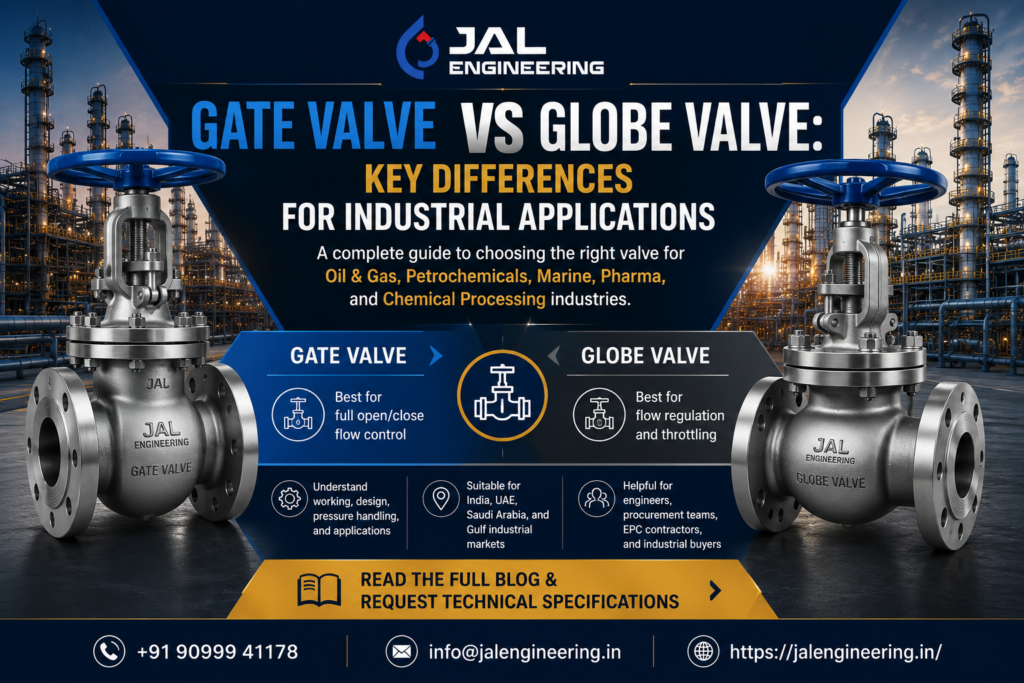
A Technical Guide for Industrial Buyers in India and Gulf Countries
Introduction: Why Choosing the Right Valve Matters
In industrial piping systems, valves are not just components. They are the control points that decide the safety, efficiency, and long-term reliability of your entire plant or pipeline network.
For procurement managers, EPC contractors, and plant maintenance teams across India, the UAE, Saudi Arabia, Qatar, Oman, Kuwait, and Bahrain — two valve types appear in almost every project specification: JAL Engineering supplies a complete range of industrial valves, pipes, and fittings to buyers across India and Gulf countries
They may look similar from the outside. Both have handwheels. Both can stop flow. But their internal design, function, pressure behavior, and application suitability are completely different.
Choosing the wrong valve — even a high-quality one — for the wrong application causes premature failure, costly maintenance shutdowns, and in high-pressure environments, serious safety risks.
This guide gives you a clear, technically accurate, and practically useful comparison of gate valves and globe valves — with a detailed comparison table, industry-wise applications, and expert advice on which valve to specify for your project.
Quick Answer: Gate valves are designed for full on/off isolation. Globe valves are designed for flow regulation and throttling. The right choice depends on your specific process requirements.
1. What Is a Gate Valve?
A gate valve is a linear motion valve that uses a flat or wedge-shaped gate (disc) to control the flow of fluid through a pipe.
When the handwheel is turned to open the valve, the gate lifts vertically out of the flow path — allowing fluid to pass through with virtually no obstruction. When closed, the gate presses firmly against two seating surfaces, creating a tight bi-directional shut-off.
How Does a Gate Valve Work?
The gate is connected to a threaded stem. Rotating the handwheel moves the stem up or down, raising or lowering the gate. Most gate valves require multiple turns to go from fully closed to fully open — making them slow-acting but highly reliable isolation devices.
The most critical design feature of a gate valve is its full-bore flow path. When fully open, the internal diameter matches the pipe bore — meaning fluid travels in a straight line with almost zero pressure drop.
Looking for a reliable gate valve supplier? Explore our full industrial valve product range or contact us for a quote.
Key Features of Gate Valves
- Full-bore or near full-bore flow path
- Bi-directional flow and shut-off capability
- Very low pressure drop when fully open
- Not suitable for throttling or partial opening
- Available in rising stem and non-rising stem designs
- Manufactured as per API 600, API 602, ASME B16.34 standards
- Available from DN15 (½ inch) to DN1200 (48 inch) and larger
- Pressure classes from ASME 150 to ASME 2500
- Materials: Carbon Steel (A216 WCB), SS304, SS316, Alloy Steel, Duplex, Super Duplex
Types of Gate Valves
- Wedge Gate Valve — Most common; single or double wedge disc for positive shut-off
- Parallel Slide Gate Valve — Two parallel discs; preferred for high-temperature steam
- Slab Gate Valve — Flat gate with through bore; used in pipelines requiring pigging
- Knife Gate Valve — Thin blade design for slurry, wastewater, or bulk material service
- Through Conduit Gate Valve — Full bore exactly matching pipe ID; used in oil transmission pipelines
Procurement Tip: Always specify rising stem or non-rising stem. Rising stem allows visual confirmation of open/closed position — preferred in above-ground installations.
2. What Is a Globe Valve?
A globe valve is a linear motion valve specifically designed for regulating, throttling, or controlling the rate of flow in a pipeline.
Unlike the gate valve, the globe valve does not have a straight-through flow path. Fluid must change direction twice inside the valve body — creating a Z-shaped or S-shaped internal path that allows precise control of flow volume.
JAL Engineering manufactures globe valves along with butterfly valves, check valves, and ball valves for all industrial applications
How Does a Globe Valve Work?
Inside a globe valve, a disc (or plug) moves up and down to open or close an orifice (seat ring). When the disc is lifted away from the seat, fluid flows through the orifice. The further the disc is raised, the greater the flow rate.
This design allows fine adjustment of flow — which is something a gate valve simply cannot do without damaging its internal components.
The name “globe valve” comes from the traditional spherical external body shape, although modern designs include angle body and Y-pattern body configurations.
Key Features of Globe Valves
- Excellent throttling and flow regulation capability
- Higher pressure drop compared to gate valves due to directional flow change
- Can be used for both isolation and regulation duties
- Good shut-off capability with replaceable disc and seat
- Available in straight body, angle body, and Y-pattern designs
- Manufactured as per API 623, BS 1873, ASME B16.34 standards
- Available from DN15 (½ inch) to DN600 (24 inch)
- Pressure classes from ASME 150 to ASME 2500
- Materials: Carbon Steel, SS304, SS316, Alloy Steel, Bronze, Hastelloy
Types of Globe Valves
- Z-Body Globe Valve — Standard design; most common in industrial service
- Y-Pattern Globe Valve — Inclined stem reduces pressure drop; preferred in high-pressure or high-temperature steam service
- Angle Globe Valve — 90-degree body design; used where space is limited or flow must change direction
- Needle Globe Valve — Very fine orifice for precision flow measurement and laboratory control
- Pressure-Seal Globe Valve — For critical high-pressure, high-temperature service in power plants and refineries
3. Gate Valve and Globe Valve Difference — Detailed Explanation
The fundamental difference is purpose: gate valves are for isolation, globe valves are for flow control. But this single-line answer is not enough for industrial specification.
Here is a detailed breakdown of the most important differences:
3.1 Flow Path and Pressure Drop
A gate valve allows fluid to travel in a straight, unobstructed path when fully open. The result is near-zero pressure drop — making gate valves ideal for long-distance pipelines where conserving pressure is critical.
A globe valve changes the direction of flow internally. The fluid enters, turns downward through the seat orifice, then turns again at the outlet. This Z-shaped path creates a consistent, measurable pressure drop — but this same resistance is what enables accurate flow control.
3.2 Throttling and Flow Control
Gate valves are not designed for throttling. When a gate valve is held partially open, the high-velocity fluid passing around the partially lifted gate causes intense erosion on the disc and seat — leading to wire drawing, leakage, and early failure. Gate valves must be operated either fully open or fully closed.
Globe valves are engineered specifically for throttling. The disc-to-seat geometry handles partial flow conditions without damage, making them the correct specification wherever flow modulation is required.
3.3 Sealing and Shut-Off
Gate valves provide excellent bi-directional shut-off. The wedge or parallel disc presses against two seating surfaces simultaneously — making gate valves the preferred choice for tight isolation of hazardous or high-pressure media.
Globe valves provide reliable shut-off as well, typically in a single direction. Advanced soft-seat globe valves can achieve zero-leakage shut-off and are acceptable for many isolation duties, especially in smaller line sizes.
3.4 Operating Speed
Both are multi-turn valves. Gate valves generally require more turns because the gate must travel the full pipe diameter. Globe valves require fewer turns because only a short disc travel is needed to open or close the orifice — making them faster to operate and more suitable for actuated (automated) applications.
3.5 Maintenance
Gate valves have simple internal geometry and relatively low wear under correct usage. However, if misused for throttling, the resulting erosion can make proper sealing impossible — requiring full valve replacement.
Globe valves have replaceable disc and seat components. Because wear is concentrated on a small, replaceable seat area, globe valves in throttling service are easier and cheaper to maintain over time.
4. Gate Valve vs Globe Valve — Comparison Table
| Parameter | Gate Valve | Globe Valve |
|---|---|---|
| Primary Function | Isolation / On-Off control | Flow regulation / Throttling |
| Flow Direction | Straight-line (linear flow path) | Changes direction (Z/Y/Angle body) |
| Pressure Drop | Very low when fully open | Higher due to directional flow change |
| Throttling Suitability | Not recommended | Excellent for precise flow control |
| Operating Speed | Slow (multi-turn) | Moderate (fewer turns needed) |
| Closure Element | Wedge, slab, or parallel disc | Plug or disc with flat/needle seat |
| Sealing | Tight shut-off; bi-directional | Good shut-off; uni or bi-directional |
| Flow Path | Full bore; minimum obstruction | Restricted; S-shaped path |
| Pipe Size Range | DN15 to DN1200+ | DN15 to DN600 |
| Material Options | CS, SS, Alloy Steel, Duplex | CS, SS, Alloy Steel, Bronze, Hastelloy |
| End Connections | Flanged, BW, SW, Threaded | Flanged, BW, SW, Threaded |
| Standards | API 600, API 602, ASME B16.34 | API 623, BS 1873, ASME B16.34 |
| Pressure Class | ASME 150 to 2500 | ASME 150 to 2500 |
| Temperature Range | −196°C to +650°C | −196°C to +450°C |
| Maintenance | Simple; low seat/disc wear | Moderate; replaceable disc and seat |
| Cost | Lower for large diameters | Slightly higher for precision builds |
| Best For | Oil & Gas, Water, Marine, Power | Pharma, Chemical, HVAC, Steam lines |
Need help selecting the right valve? Browse our complete products page or get in touch with our technical team
5. When Should You Use a Gate Valve?
Use a gate valve when your application requires any of the following:
Full On/Off Isolation
Gate valves are the first choice wherever a pipeline section or process equipment needs to be completely isolated — for maintenance, emergency shutdown, or routine operational control.
Minimum Pressure Drop
Where the system cannot afford to lose pressure — such as long-distance oil and gas transmission pipelines, water distribution mains, or cooling water circuits — gate valves are specified because their full-bore design adds virtually no resistance when open.
Large Diameter Piping
Gate valves are the practical and economical choice for large diameter pipelines (DN200 and above). Globe valves in large sizes become extremely heavy, expensive, and difficult to operate.
Pigging Operations
In pipelines that are cleaned or inspected using pipeline pigs (inspection tools passed through the pipe), through-conduit gate valves with full-bore design are mandatory. Globe valves cannot accommodate pigging operations.
Infrequent Operation
Gate valves are well-suited to valves that remain fully open for long periods and are only closed occasionally for maintenance or emergency shutdown.
Typical Gate Valve Applications:
- Oil wellheads and production manifolds
- Crude oil and natural gas transmission pipeline mainlines
- Marine ballast water and sea water intake systems
- Potable water mains and fire water distribution
- Power plant main steam isolation and feedwater lines
- Refinery process unit block valves
- LNG terminal loading and unloading lines
6. When Should You Use a Globe Valve?
Use a globe valve when your application requires any of the following:
Flow Regulation and Throttling
Wherever flow rate needs to be adjusted — setting a specific flow to a reactor, dosing a chemical at a controlled volume, or maintaining a set temperature by controlling steam flow — a globe valve is the correct specification.
Frequent Operation
Globe valves handle frequent opening and closing cycles far better than gate valves. The disc-to-seat contact area is small and designed for repeated use without damage.
Precision Flow Control
In pharmaceutical manufacturing, chemical reactors, and laboratory services where flow must be controlled with high precision, globe valves — particularly needle-type designs — are the only practical choice.
Steam Service
Globe valves are the standard choice for steam service — including heat exchangers, steam traps, turbine bypass lines, and boiler feed systems. Y-pattern globe valves are preferred for high-pressure steam applications.
Smaller Line Sizes
For pipe sizes up to DN50–DN80 (2–3 inches), globe valves are often preferred even for simple isolation duties because of their compact size, ease of operation, and reliable shut-off.
Typical Globe Valve Applications:
- Cooling water flow control to heat exchangers
- Boiler feed water and steam condensate systems
- Chemical reactor feed and discharge control
- Pharmaceutical dosing and sterile media control
- Fuel oil control to burners and industrial furnaces
- Instrumentation root valves and bypass lines
- HVAC chilled water system balancing
- Turbine bypass and gland steam control
7. Industry-Wise Applications
| Industry | Recommended Valve | Typical Use Case |
|---|---|---|
| Oil & Gas | Gate Valve (primary) | Wellhead isolation, pipeline mainlines, manifold blocks |
| Petrochemicals | Both | Gate for isolation; Globe for reactor feed control |
| Marine Shipping | Gate Valve | Ballast lines, sea water intake, cargo oil pipelines |
| Pharmaceuticals | Globe Valve | Sterile media control, CIP lines, dosing systems |
| Chemical Processing | Globe Valve (primary) | Acid lines, dosing control, catalyst feed systems |
| Power Generation | Both | Gate for main steam isolation; Globe for bypass/drain |
| Water Treatment | Gate Valve | Main water mains, distribution lines, pump suctions |
| HVAC Systems | Globe Valve | Balancing and flow regulation in chilled water loops |
Oil & Gas Industry
The oil and gas sector is the largest consumer of industrial valves globally. In the Gulf region — UAE, Saudi Arabia, Qatar, Oman — this sector drives the majority of valve procurement activity.
- Gate valves dominate mainline, wellhead, and manifold isolation duties due to their full-bore design and near-zero pressure drop
- Globe valves handle bypass lines, pressure control, drain and vent lines, and precise flow regulation in process units
- Both types are required in ASME 600, 900, and 1500 pressure classes for high-pressure service
- Typical materials include Carbon Steel (A216 WCB) for standard service and Alloy Steel (F11, F22) or Stainless Steel (F316) for sour, corrosive, or high-temperature environments
Petrochemicals
Petrochemical plants process a wide range of hydrocarbons and chemicals under varying temperature and pressure conditions. Both valve types are essential.
- Gate valves handle main process line isolation for reactors, distillation columns, and storage tanks
- Globe valves manage precise flow control of feedstocks, intermediate products, and utility streams
- Duplex and Super Duplex stainless steel valves are specified for high chloride or sour service environments
Marine and Offshore
Marine applications — including commercial shipping, offshore platforms, and LNG carriers — require valves that withstand salt water, vibration, and demanding operating conditions.
- Gate valves are the primary choice for sea water intake, ballast, bilge, and cargo oil systems
- Bronze or naval brass gate valves are used for sea water service due to their corrosion resistance
- Globe valves handle fuel oil control, cooling water regulation, and steam heating systems on board ships
- All marine valves must meet classification society standards: DNV-GL, Lloyd’s Register, Bureau Veritas, or ABS
Pharmaceuticals
Pharmaceutical manufacturing demands the highest standards of hygiene and flow control accuracy. Process media include sterile water, APIs (active pharmaceutical ingredients), and CIP/SIP solutions.
- Globe valves — particularly hygienic or sanitary designs — are standard in pharmaceutical process systems
- Material is almost exclusively SS316L with Ra 0.5 or better internal finish
- Globe valves are used for dosing, media transfer, and CIP line control
- Gate valves handle bulk utility isolation such as purified water storage and distribution
Chemical Processing
Chemical plants handle corrosive acids, bases, solvents, and reactive compounds that demand carefully selected valve materials.
- Globe valves are preferred for chemical dosing, reactor flow control, and neutralization systems
- Exotic material globe valves (Hastelloy C276, Monel, Titanium) are specified for highly corrosive media
- Gate valves handle main line isolation for storage tank outlets and plant emergency shutdown systems
8. Which Valve Is Better for Industrial Use?
There is no universal answer — and any supplier who tells you one valve is always better than the other is oversimplifying a decision that must be based on your actual application.
The Professional Answer: Gate valves are better for isolation. Globe valves are better for flow control. The best valve is the one correctly engineered for your specific pressure, temperature, fluid type, and operational pattern.
Choose a Gate Valve When:
- You need full on/off isolation with tight bi-directional shut-off
- Pressure drop must be minimized
- The pipeline requires pigging
- Pipe size is DN200 or larger
- The valve will remain open for long periods and close only for maintenance
- The application is a main block valve on an oil, gas, or water pipeline
Choose a Globe Valve When:
- You need to regulate or throttle flow rate
- The valve will be operated frequently
- Precise flow control is required (dosing, reactor feed, heating/cooling)
- The application is on a bypass, drain, vent, or instrument line
- Steam service requires both isolation and flow control capability
- The application involves pharmaceutical, chemical, or food-grade media
9. Importance of Choosing the Right Valve Manufacturer
Valve quality directly determines plant safety and long-term operational cost. A low-quality valve that fails in a high-pressure oil and gas system or a critical pharmaceutical line can cause equipment damage, production loss, environmental incidents, and in severe cases, loss of life.
For buyers in India and Gulf countries, selecting a manufacturer with proven credentials is not optional — it is a fundamental procurement requirement.
For a detailed list of top manufacturers, read our blog: Top 10 Ball Valve Manufacturers in India (2026) and Top 10 SS Pipe Fittings Manufacturers in India.
What to Look for in a Valve Manufacturer
- ISO 9001 Certification — Confirms the quality management system meets international standards
- API and ASME Compliance — Ensures valves are designed per API 600 (gate valves), API 623 (globe valves), and ASME B16.34
- Third-Party Inspection Support — Ability to accommodate TPI from Bureau Veritas, Lloyd’s, TUV, SGS, or TPIA
- Material Traceability — Full Material Test Reports (MTRs) traceable to the melt and heat of raw material
- Pressure Testing Documentation — Hydrostatic shell and seat test certificates per API 598
- Export Experience — Familiarity with documentation (Certificate of Origin, MSDS, Packing List) for Gulf region imports
- Technical Support — Engineering support, dimensional drawings, and valve sizing calculations
Why India Is a Preferred Sourcing Hub for Gulf Buyers
India — and Ahmedabad in particular — is one of the world’s leading manufacturing and export hubs for industrial valves, pipes, fittings, and flanges.
- India-UAE CEPA trade agreement reduces import duties significantly on qualifying products
- Indian manufacturers comply fully with API, ASME, PED, and ATEX standards
- Shorter lead times and more competitive pricing than European or North American sources
- Established logistics routes between Indian ports (Mundra, JNPT) and Gulf ports (Jebel Ali, Hamad, Salalah)
- Proven supply track record for Saudi Aramco, ADNOC, KNPC, PDO, and QatarEnergy projects
10. Why JAL Engineering for Industrial Valves, Pipes & Fittings?
JAL Engineering is a leading manufacturer and supplier of industrial valves, stainless steel pipes, pipe fittings, and flanges based in Ahmedabad, India. With extensive experience serving industrial buyers across India and the Gulf region, JAL Engineering is a trusted sourcing partner for EPC contractors, procurement managers, OEM buyers, and distributors.
Our Product Range
- Valves: Gate Valves, Globe Valves, Ball Valves, Check Valves, Butterfly Valves, Needle Valves, Safety Relief Valves
- Pipes: Stainless Steel Pipes, Carbon Steel Pipes, Alloy Steel Pipes, ERW Pipes, Seamless Pipes
- Pipe Fittings: Elbows, Tees, Reducers, Couplings, Unions — in all standard sizes and grades
- Flanges: Weld Neck, Slip-On, Blind, Socket Weld, Lap Joint — in all ASME pressure classes
Unlike ball valves, gate valves use a rising or non-rising stem with a wedge disc for isolation
Standards and Compliance
- ISO 9001 Quality Management System
- Gate Valves: API 600, API 602, API 603
- Globe Valves: API 623, BS 1873
- Dimensional Standards: ASME B16.5, B16.34, B16.10
- Pipe Standards: ASTM A312, A358, A106, A335
- Fitting Standards: ASME B16.9, B16.11, MSS SP-75
Industries We Serve
- Oil & Gas — upstream, midstream, and downstream
- Petrochemicals and Refineries
- Marine and Offshore
- Pharmaceuticals and Biotechnology
- Chemical Processing and Specialty Chemicals
- Power Generation and Utilities
- Water Treatment and Infrastructure
Why Gulf Buyers Choose JAL Engineering
- Competitive pricing with full export documentation support
- India-UAE CEPA benefits: reduced duty on qualifying products
- Third-party inspection coordination — TUV, SGS, Bureau Veritas, Lloyd’s
- Material Test Reports (MTRs) and Hydrostatic Test Certificates for every order
- Experienced export team handling logistics to UAE, Saudi Arabia, Qatar, Oman, Kuwait, and Bahrain
- Technical support for valve sizing, material selection, and specification review
- Fast quotation turnaround — within 24–48 hours
Ready to Source Industrial Valves?
Contact JAL Engineering for pricing, technical datasheets, material certificates, and delivery schedules. We respond to all industrial inquiries from India and Gulf countries within 24 hours.Email: info@jalengineering.in
11. Conclusion
Understanding the difference between gate valves and globe valves is a practical necessity for anyone involved in industrial piping design, procurement, or plant operations.
To summarise:
- Gate valves are your go-to for full-bore isolation, minimal pressure drop, and mainline pipelines in oil and gas, marine, and water systems
- Globe valves are the correct specification wherever flow needs to be regulated, throttled, or precisely controlled — in chemical, pharmaceutical, steam, and HVAC applications
Selecting the right valve type and sourcing it from a qualified, certified manufacturer significantly reduces operational risk, maintenance costs, and total cost of ownership over the life of your plant or pipeline.
For industrial buyers and procurement teams in India, the UAE, Saudi Arabia, Qatar, Oman, Kuwait, and Bahrain — JAL Engineering offers a dependable supply of both gate valves and globe valves, manufactured to international standards, fully documented, and supported by experienced technical and export teams.
Ready to source gate valves, globe valves, ball valves, SS pipes, pipe fittings, or flanges for your next project? Contact JAL Engineering today for a fast quote.
12. Frequently Asked Questions
Q1. What is the main difference between a gate valve and a globe valve?
A gate valve is designed for full on/off isolation with minimal pressure drop when fully open. A globe valve is designed for flow regulation and throttling. Gate valves must be operated either fully open or fully closed. Globe valves are built to handle partial opening for precise flow control without damage to internal components.
Q2. Can a gate valve be used for throttling?
No. Using a gate valve in a partially open position causes severe erosion of the disc and seat due to high-velocity fluid turbulence. This leads to wire drawing, seat leakage, and early valve failure. Globe valves are the correct choice for all throttling applications.
Q3. Which valve is better for oil and gas pipelines?
Gate valves are preferred for oil and gas mainline pipelines. Their full-bore design ensures minimum pressure drop, they provide reliable bi-directional isolation, and through-conduit or slab gate valves can accommodate pipeline pigging. Globe valves serve secondary control and regulation duties in the same industry.
Q4. What is the pressure drop difference between a gate valve and a globe valve?
A fully open gate valve has near-zero pressure drop because the disc retracts completely from the flow path, leaving an unobstructed bore. A globe valve has a higher, measurable pressure drop because fluid must change direction twice through the Z-shaped internal flow path. This consistent resistance is what enables flow regulation.
Q5. What materials are gate and globe valves made from?
Both types are available in Carbon Steel (A216 WCB), Stainless Steel (SS304, SS316, SS316L), Alloy Steel (F11, F22, F91), Duplex, and Super Duplex. Globe valves are also available in Bronze, Hastelloy C276, and Monel for highly corrosive chemical and pharmaceutical applications.
Q6. Which valve is best for pharmaceutical and chemical industries?
Globe valves are the standard choice for pharmaceutical and chemical processing. They provide accurate, repeatable flow control, are available in hygienic (sanitary) designs with SS316L construction, and can be cleaned effectively in CIP (clean-in-place) systems. Needle globe valves are used where the highest precision is required in dosing and laboratory applications.
Q7. Are gate valves suitable for marine applications?
Yes. Gate valves are widely used in marine and offshore applications for sea water intake, ballast, bilge, and cargo oil systems. Bronze or gunmetal gate valves are preferred for sea water service due to their corrosion resistance. All marine valves must be approved by classification societies such as DNV-GL, Lloyd’s Register, or Bureau Veritas.
Q8. What standards govern gate valve and globe valve manufacturing?
Gate valves are manufactured per API 600 (steel gate valves for petroleum service), API 602 (compact gate valves), and ASME B16.34. Globe valves follow API 623 and BS 1873. Both valve types are tested per API 598 (valve inspection and testing standard).
Q9. How do I choose a reliable valve manufacturer in India or the UAE for Gulf projects?
Look for ISO 9001 certification, compliance with API and ASME standards, full material traceability (MTRs), hydrostatic test certificates, and third-party inspection support from recognized agencies. Prefer manufacturers with proven export experience to Gulf countries and familiarity with Gulf project documentation requirements.
Q10. Does JAL Engineering export valves and pipes to Gulf countries?
Yes. JAL Engineering exports industrial valves, SS pipes, buttweld fittings, and flanges to the UAE, Saudi Arabia, Qatar, Oman, Kuwait, and Bahrain. Contact us for pricing and delivery details.