Ordering the wrong pipe schedule is one of the most common (and costly) mistakes in industrial procurement. Two SS pipes can share the exact same outer diameter yet carry completely different pressure ratings the difference comes down to wall thickness, which is what “schedule” actually means. This pipe schedule chart guide breaks down what each schedule number represents and how to pick the right one for your application.
Quick Answer
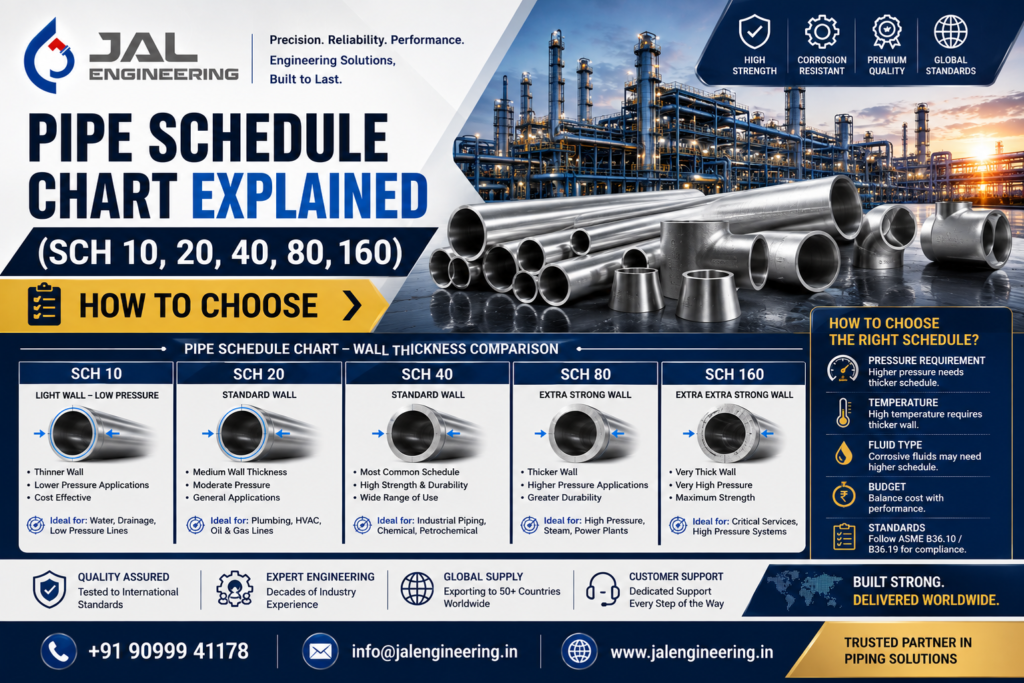
Pipe schedule (SCH) indicates the wall thickness of a pipe relative to its outer diameter a higher schedule number means a thicker wall and higher pressure rating, not a bigger pipe. For low-pressure water or utility lines, SCH 10 or SCH 20 is typically sufficient. For general industrial process piping, SCH 40 is the most common standard. For high-pressure steam, chemical, or oil & gas applications, SCH 80 or SCH 160 is required.
What Does “Pipe Schedule” Actually Mean?
Pipe schedule is a standardized system (defined under ASME B36.19 for stainless steel and B36.10 for carbon steel) that specifies the wall thickness of a pipe for a given nominal pipe size (NPS). Importantly, the outer diameter stays the same across schedules for a given pipe size only the inner diameter and wall thickness change as the schedule number increases.
This means a 2-inch SCH 40 pipe and a 2-inch SCH 80 pipe look the same from outside, but the SCH 80 pipe has a thicker wall, a smaller bore, and can handle significantly higher internal pressure.
Pipe Schedule Chart — Wall Thickness Comparison (2″ NPS Example)
| Schedule | Wall Thickness (mm) | Inner Diameter (mm) | Typical Use Case |
|---|---|---|---|
| SCH 10 | 2.77 | 60.30 | Low-pressure water, HVAC, light-duty lines |
| SCH 20 | 3.18 | 59.46 | Low to moderate pressure utility piping |
| SCH 40 (Standard) | 3.91 | 58.14 | General industrial process piping |
| SCH 80 (Extra Strong) | 5.54 | 54.76 | High-pressure steam, chemical, oil & gas lines |
| SCH 160 | 8.74 | 47.02 | Very high-pressure and high-temperature service |
Note: Values shown are for 2″ NPS pipe as a reference example. Wall thickness and bore vary by nominal pipe size — always confirm exact dimensions against the ASME B36.19/B36.10 dimensional tables for your specific pipe size.
How to Choose the Right Pipe Schedule
Selecting the correct schedule depends on three main factors:
- Operating pressure — Higher internal pressure requires a thicker wall (higher schedule) to prevent rupture.
- Operating temperature — High-temperature service (like steam lines) often demands SCH 80 or higher, since material strength decreases as temperature rises.
- Corrosion/erosion allowance — In corrosive chemical or abrasive slurry applications, a thicker wall (higher schedule) provides extra material margin over the pipe’s service life.
As a general industry rule of thumb:
- SCH 10/20 — Low-pressure water, drainage, and light utility lines
- SCH 40 — The default “standard weight” choice for most general industrial piping
- SCH 80 — “Extra strong” — used wherever pressure or temperature exceeds standard limits
- SCH 160 — Reserved for extreme pressure/temperature applications such as high-pressure steam and specialty process lines
Once you’ve confirmed the right schedule for your pipe, the next step is choosing how it connects to fittings and valves. Our guide on buttweld fittings vs threaded fittings vs socket weld fittings explains which connection type suits your pressure rating and pipe size.
Frequently Asked Questions
Q: Does a higher pipe schedule mean a bigger pipe? No. The outer diameter remains constant for a given nominal pipe size across all schedules — a higher schedule number only means a thicker wall and smaller inner bore, not a larger pipe overall.
Q: What is the difference between SCH 40 and SCH 80 pipe? SCH 80 pipe has a thicker wall than SCH 40 for the same nominal size, giving it a higher pressure rating and smaller internal bore, at a higher material cost.
Q: Which pipe schedule is most commonly used in industrial piping? SCH 40 is the most widely used “standard weight” schedule for general industrial process piping, while SCH 80 is common wherever higher pressure or temperature is involved.
Q: Is pipe schedule the same as pipe class or pressure rating? No. Pipe schedule refers specifically to wall thickness, while pressure/temperature rating (like ANSI Class 150, 300, 600) is a separate specification often used for flanges and valves, though both relate to a system’s overall pressure capability.
Q: Can I use SCH 40 for high-pressure steam lines? Generally no — high-pressure steam applications typically require SCH 80 or higher to safely withstand the combined effects of high pressure and elevated temperature.
Related Reading
- Buttweld Fittings vs Threaded Fittings vs Socket Weld Fittings — Which to Use
- Top 10 SS Pipe Fittings Manufacturers in India (2026 Guide)
- Which Stainless Steel Valves Are Best for Industrial Applications?
Explore JAL Engineering’s full range of SS Pipes and Buttweld Fittings manufactured to ASME standards in Ahmedabad and supplied across India and export markets.